






9RUV
X-ray structure of the adduct formed upon reaction of dirhodium-tetraacetate with lysozyme at body temperature
This is a non-PDB format compatible entry.
Summary for 9RUV
| Entry DOI | 10.2210/pdb9ruv/pdb |
| Descriptor | Lysozyme C, Rhodium, SODIUM ION, ... (4 entities in total) |
| Functional Keywords | dirhodium compound, protein metalation, body temperature crystalography, hydrolase |
| Biological source | Gallus gallus (chicken) |
| Total number of polymer chains | 1 |
| Total formula weight | 15074.49 |
| Authors | |
| Primary citation | Tito, G.,Ferraro, G.,Merlino, A. Dirhodium Tetraacetate Binding to Lysozyme at Body Temperature. Int J Mol Sci, 26:-, 2025 Cited by PubMed Abstract: Paddlewheel dirhodium complexes are cytotoxic compounds that are also used as catalysts and in the formation of Rh-based artificial metalloenzymes. Low-temperature structures of adducts formed by the model protein hen egg white lysozyme (HEWL) with dirhodium tetraacetate ([Rh(μ-OCCH)]) when crystals of the protein were treated with the metal compound at 20 °C demonstrated that [Rh(μ-OCCH)] in part breaks down upon reaction with HEWL; dimeric Rh-Rh units bind the side chains of Asp18 and the C-terminal carboxylate, and monometallic fragments coordinate the side chains of Arg14 and His15 in 20% ethylene glycol, 0.100 M sodium acetate at pH 4.5 and 0.600 M sodium nitrate, while dimeric Rh-Rh units bind the side chains of Asn93 and Lys96, the C-terminal carboxylate and Asp101, with monometallic fragments that bind the side chains of Lys33 and His15 in 0.010 M HEPES pH 7.5 and 2.00 M sodium formate. To verify whether the binding of this metallodrug to proteins also occurs at body temperature, crystals of HEWL were grown in 0.010 M HEPES pH 7.5 and 2.00 M sodium formate at 37 °C and soaked with [Rh(μ-OCCH)] at the same temperature. X-ray diffraction data collected on these crystals at 37 °C demonstrate that [Rh(μ-OCCH)] reacts with proteins at body temperature. The structures of the Rh/HEWL adduct formed at 20 °C (obtained from data collected at 100 K) and at 37 °C under the same experimental conditions are very similar, with metal binding sites that are conserved. However, metal-containing fragment occupancy is higher in the structure obtained at 37 °C, suggesting a role of temperature in defining the protein metalation process. PubMed: 40724832DOI: 10.3390/ijms26146582 PDB entries with the same primary citation |
| Experimental method | X-RAY DIFFRACTION (2.12 Å) |
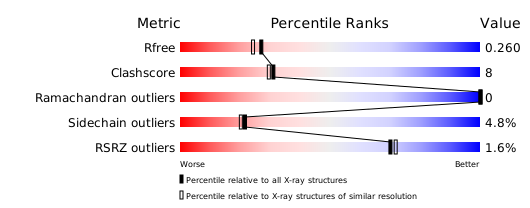
Structure validation
Download full validation report


