






Summary for 9RD1
| Entry DOI | 10.2210/pdb9rd1/pdb |
| Related | 3TCF |
| Descriptor | Periplasmic oligopeptide-binding protein OppA, Gly-Ser-epsilon-Lys, (R,R)-2,3-BUTANEDIOL, ... (6 entities in total) |
| Functional Keywords | substrate recognition specificity, binding pocket plasticity, transporter-ligand interactions, structural basis for selective uptake, scaffold accommodation, transport protein |
| Biological source | Escherichia coli More |
| Total number of polymer chains | 4 |
| Total formula weight | 238002.86 |
| Authors | Iype, T.,Fottner, M.,Boehm, P.,Piedrafita, C.,Moeller, Y.,Groll, M.,Lang, K. (deposition date: 2025-05-30, release date: 2025-08-13, Last modification date: 2025-10-29) |
| Primary citation | Iype, T.,Fottner, M.,Bohm, P.,Piedrafita, C.,Moller, Y.,Groll, M.,Lang, K. Hijacking a bacterial ABC transporter for genetic code expansion. Nature, 2025 Cited by PubMed Abstract: The site-specific encoding of non-canonical amino acids (ncAAs) provides a powerful tool for expanding the functional repertoire of proteins. Its widespread use for basic research and biotechnological applications is, however, hampered by the low efficiencies of current ncAA incorporation strategies. Here we reveal poor cellular ncAA uptake as a main obstacle to efficient genetic code expansion and overcome this bottleneck by hijacking a bacterial ATP-binding cassette (ABC) transporter to actively import easily synthesizable isopeptide-linked tripeptides that are processed into ncAAs within the cell. Using this approach, we enable efficient encoding of a variety of previously inaccessible ncAAs, decorating proteins with bioorthogonal and crosslinker moieties, post-translational modifications and functionalities for chemoenzymatic conjugation. We then devise a high-throughput directed evolution platform to engineer tailored transporter systems for the import of ncAAs that were historically refractory to efficient uptake. Customized Escherichia coli strains expressing these evolved transporters facilitate single and multi-site ncAA incorporation with wild-type efficiencies. Additionally, we adapt the tripeptide scaffolds for the co-transport of two different ncAAs, enabling their efficient dual incorporation. Collectively, our study demonstrates that engineering of uptake systems is a powerful strategy for programmable import of chemically diverse building blocks. PubMed: 41094137DOI: 10.1038/s41586-025-09576-w PDB entries with the same primary citation |
| Experimental method | X-RAY DIFFRACTION (2.5 Å) |
Structure validation
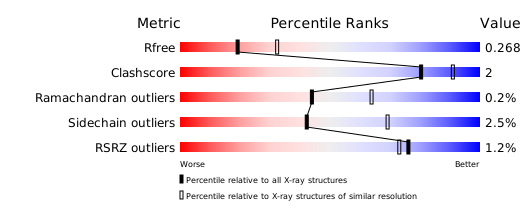
Download full validation report


