






 9RCC
9RCC
PrPfr hybrid state of the Pseudomonas aeruginosa bacteriophytochrome / PaBphP
9RCC の概要
| エントリーDOI | 10.2210/pdb9rcc/pdb |
| EMDBエントリー | 53916 |
| 分子名称 | Bacteriophytochrome, 3-[2-[(Z)-[3-(2-carboxyethyl)-5-[(Z)-(4-ethenyl-3-methyl-5-oxidanylidene-pyrrol-2-ylidene)methyl]-4-methyl-pyrrol-1-ium -2-ylidene]methyl]-5-[(Z)-[(3E)-3-ethylidene-4-methyl-5-oxidanylidene-pyrrolidin-2-ylidene]methyl]-4-methyl-1H-pyrrol-3- yl]propanoic acid (2 entities in total) |
| 機能のキーワード | phytochrome, bacteriophytochrome, photoreceptor, histidine kinase, cytosolic protein |
| 由来する生物種 | Pseudomonas aeruginosa |
| タンパク質・核酸の鎖数 | 2 |
| 化学式量合計 | 163218.75 |
| 構造登録者 | |
| 主引用文献 | Bodizs, S.,Fischer, A.M.,Cervenak, M.,Prodhan, S.,Maj, M.,Westenhoff, S. Chemical Mechanism of Allosteric and Asymmetric Dark Reversion in a Bacterial Phytochrome Uncovered by Cryo-EM. J.Am.Chem.Soc., 147:45701-45711, 2025 Cited by PubMed Abstract: Phytochromes are light-sensitive proteins that are found in plants, fungi, and bacteria. They exist in two functional states, Pr and Pfr, distinguished by / isomers of their bilin chromophore. The chromophore can photoswitch between these states but also thermally converts in darkness. Despite the importance of the latter reaction, it is unknown how it is controlled by the phytochrome's structure. Here, we present single-particle cryo-EM measurements on the bacteriophytochrome (PaBphP) carried out at multiple time points during dark reversion from Pr to Pfr. These experiments resolved the structure of a PrPfr hybrid state as a transient intermediate. Surprisingly, we find that only protomer B converts back to Pfr in the hybrid, while protomer A remains in Pr. We identify structural asymmetries in the precursor Pr state, which extend from the homodimer interface to a conserved histidine (H277). The hydrogen-bonding network around the chromophore is modulated, explaining how a phytochrome exerts control over the isomerization reaction. These findings establish that dark reversion is governed by conformational selection between two substates, whereby one is "dark-reversion ready" and the other blocks the reaction. Moreover, we explain how the equilibrium of the states is allosterically controlled across the dimer. Together, these findings provide a structural framework for tuning phytochrome signaling lifetimes in optogenetic applications. PubMed: 41317121DOI: 10.1021/jacs.5c17531 主引用文献が同じPDBエントリー |
| 実験手法 | ELECTRON MICROSCOPY (2.8 Å) |
構造検証レポート
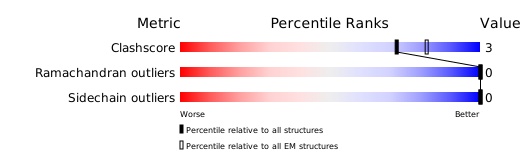
検証レポート(詳細版) をダウンロード
をダウンロード


