






 9QS9
9QS9
Structure and mechanism of the broad spectrum CRISPR-associated ring nuclease Crn4
9QS9 の概要
| エントリーDOI | 10.2210/pdb9qs9/pdb |
| 分子名称 | Crn4 H15A, Cyclic polyA, MAGNESIUM ION, ... (4 entities in total) |
| 機能のキーワード | crispr, ring nuclease, cyclic oligoadenylate, phage, viral protein, cell invasion |
| 由来する生物種 | Actinomyces procaprae 詳細 |
| タンパク質・核酸の鎖数 | 9 |
| 化学式量合計 | 102297.19 |
| 構造登録者 | McMahon, S.A.,Chi, H.,Hoikkala, V.,Gloster, T.M.,White, M.F. (登録日: 2025-04-04, 公開日: 2025-12-03, 最終更新日: 2026-02-04) |
| 主引用文献 | Chi, H.,Hoikkala, V.,McMahon, S.,Graham, S.,Gloster, T.,White, M.F. Structure and mechanism of the broad spectrum CRISPR-associated ring nuclease Crn4. Nat Commun, 17:889-889, 2025 Cited by PubMed Abstract: Type III CRISPR systems detect the presence of RNA from mobile genetic elements (MGE) in prokaryotes, providing antiviral immunity. On activation, the catalytic Cas10 subunit conjugates ATP to form cyclic oligoadenylate (cOA) signalling molecules that activate ancillary effectors, providing an immune response. Cellular ring nucleases degrade cOA to reset the system. Here, we describe the structure and mechanism of a new family of ring nucleases, Crn4, associated with type III-D CRISPR systems. The crystal structure of Crn4 reveals a small homodimeric protein with a fold unrelated to any known ring nuclease or, indeed, any known protein structure. Crn4 degrades a wide range of cOA species to linear oligoadenylates in vitro and ameliorates type III CRISPR immunity in vivo. Phage and plasmids also encode Crn4 orthologues that may function as anti-CRISPRs. These observations expand our understanding of ring nucleases and reveal a new protein fold for cyclic nucleotide recognition. PubMed: 41398410DOI: 10.1038/s41467-025-67607-6 主引用文献が同じPDBエントリー |
| 実験手法 | X-RAY DIFFRACTION (1.441 Å) |
構造検証レポート
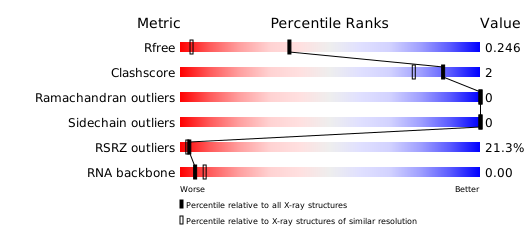
検証レポート(詳細版) をダウンロード
をダウンロード


