






9QIT
Crystal structure of a D-lactate dehydrogenase in complex with D-lactate from Porcellio dilatatus
Summary for 9QIT
| Entry DOI | 10.2210/pdb9qit/pdb |
| Descriptor | Glycolate oxidase, GLYCEROL, LACTIC ACID, ... (5 entities in total) |
| Functional Keywords | gut metagenome; oxidoreductases; lactate dehydrogenases, oxidoreductase |
| Biological source | Porcellio dilatatus |
| Total number of polymer chains | 8 |
| Total formula weight | 399414.81 |
| Authors | Borges, P.T.,Frazao, C.,Martins, L.O. (deposition date: 2025-03-17, release date: 2025-12-03, Last modification date: 2026-01-14) |
| Primary citation | Coelho, C.,Taborda, A.,Lorena, C.,Frazao, T.,Verissimo, A.,Borges, P.T.,Brissos, V.,Tiago, I.,Martins, L.O. Shotgun metagenomic mining reveals a new FAD-dependent D-lactate dehydrogenase in an isopod gut microbiome. Appl.Environ.Microbiol., 91:e0148025-e0148025, 2025 Cited by PubMed Abstract: Shotgun metagenomic sequencing has emerged as a powerful tool for exploring microbial diversity and uncovering genes encoding novel biocatalysts from complex environments. Here, we report the discovery and characterization of a new FAD-dependent D-lactate dehydrogenase (PdG-D-LDH) from the gut microbiome of the isopod . The enzyme was identified through screening using BLAST and AlphaFold3 and functionally characterized as a homodimeric, thermoactive, and thermostable protein, demonstrating the robustness required for biotechnological applications. PdG-D-LDH exhibits a strong catalytic preference toward D-lactate and preferentially reduces quinones over cytochrome or molecular oxygen. X-ray crystallography revealed a VAO/PCMH-like fold with a solvent-accessible active site that harbors both a FAD cofactor and an Fe(II) ion. Molecular docking studies provided insights into the structural determinants of its stereoselective substrate recognition. Under mild conditions, the enzyme catalyzed the oxidation of D-lactate to pyruvate with a 90% yield after 24 h of reaction, using molecular oxygen as the electron acceptor. PubMed: 41231970DOI: 10.1128/aem.01480-25 PDB entries with the same primary citation |
| Experimental method | X-RAY DIFFRACTION (3.04 Å) |
Structure validation
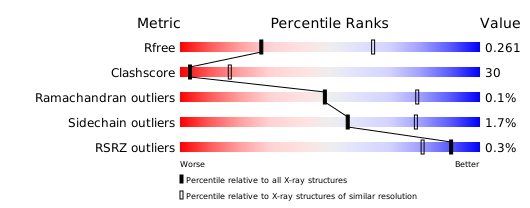
Download full validation report


