






 9QGF
9QGF
Crystal structure of an NADH-accepting ene reductase variant NostocER1-L1,5 mutant T354K
これはPDB形式変換不可エントリーです。
9QGF の概要
| エントリーDOI | 10.2210/pdb9qgf/pdb |
| 分子名称 | All1865 protein, FLAVIN MONONUCLEOTIDE, 1,2-ETHANEDIOL, ... (7 entities in total) |
| 機能のキーワード | oxidoreductase, ene reductase, cyanobacteria, achromobacter sp. ja81 loop, alkene reductase, formate dehydrogenase |
| 由来する生物種 | Nostoc sp. PCC 7120 = FACHB-418 |
| タンパク質・核酸の鎖数 | 2 |
| 化学式量合計 | 83285.27 |
| 構造登録者 | Bischoff, D.,Walla, B.,Janowski, R.,Maslakova, A.,Niessing, D.,Weuster-Botz, D. (登録日: 2025-03-13, 公開日: 2025-04-02, 最終更新日: 2025-05-14) |
| 主引用文献 | Walla, B.,Maslakova, A.,Bischoff, D.,Janowski, R.,Niessing, D.,Weuster-Botz, D. Rational Introduction of Electrostatic Interactions at Crystal Contacts to Enhance Protein Crystallization of an Ene Reductase. Biomolecules, 15:-, 2025 Cited by PubMed Abstract: Protein crystallization is an alternative to well-established but cost-intensive and time-consuming chromatography in biotechnological processes, with protein crystallization defined as an essential unit operation for isolating proteins, e.g., active pharmaceutical ingredients. Crystalline therapeutic proteins attract interest in formulation and delivery processes of biopharmaceuticals due to the high purity, concentration, and stability of the crystalline state. Although improving protein crystallization is mainly achieved by high-throughput screening of crystallization conditions, recent studies have established a rational protein engineering approach to enhance crystallization for two homologous alcohol dehydrogenases from (ADH) and (ADH). As generalizing crystallization processes across a wide range of target proteins remains challenging, this study takes a further step by applying the successful crystal contact engineering strategies for ADH/ADH to a non-homologous protein, an NADH-binding derivative of the sp. PCC 1720 ene reductase (ER1-L1,5). Here, the focus lies on introducing electrostatic interactions at crystal contacts, specifically between lysine and glutamic acid. Out of the nine tested ER1-L1,5 mutants produced in , six crystallized, while four mutants revealed an increased propensity to crystallize in static µL-batch crystallization compared to the wild type: Q204K, Q350K, D352K, and T354K. The best-performing mutant Q204K was selected for upscaling, crystallizing faster than the wild type in a stirred batch crystallizer. Even when spiked with cell lysate, the mutant maintained increased crystallizability compared to the wild type. The results of this study highlight the potential of crystal contact engineering as a reliable tool for improving protein crystallization as an alternative to chromatography, paving the way for more efficient biotechnological downstream processing. PubMed: 40305164DOI: 10.3390/biom15040467 主引用文献が同じPDBエントリー |
| 実験手法 | X-RAY DIFFRACTION (1.444 Å) |
構造検証レポート
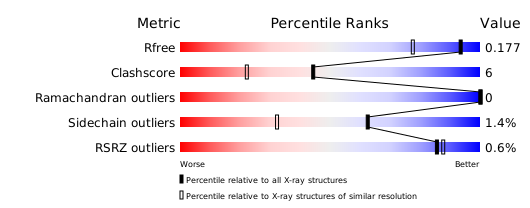
検証レポート(詳細版) をダウンロード
をダウンロード


