






 9QDB
9QDB9QDB の概要
| エントリーDOI | 10.2210/pdb9qdb/pdb |
| 分子名称 | Peptidyl-prolyl cis-trans isomerase FKBP5, (2~{S},9~{S},12~{R})-2-cyclohexyl-20,23-dimethoxy-12-methyl-11,14,18-trioxa-4-azatricyclo[17.2.2.0^{4,9}]tricosa-1(22),19(23),20-triene-3,10-dione (3 entities in total) |
| 機能のキーワード | inhibitor, complex, fkbp, isomerase |
| 由来する生物種 | Homo sapiens (human) |
| タンパク質・核酸の鎖数 | 2 |
| 化学式量合計 | 29015.31 |
| 構造登録者 | |
| 主引用文献 | Brudy, C.,Ruijsenaars, E.,Meyners, C.,Sugiarto, W.O.,Achaq, H.,Spiske, M.,Buffa, V.,Springer, M.,Repity, M.,Weller, A.,Haferkamp, U.,Pless, O.,Muschong, P.,Miltner, D.,Mezler, M.,Schmidt, M.V.,Riniker, S.,Hausch, F. Linker Modification Enables Control of Key Functional Group Orientation in Macrocycles. J.Med.Chem., 68:24890-24923, 2025 Cited by PubMed Abstract: Macrocycles are promising drug modalities that can enable unique ways of conformational preorganization, but how even minor modifications to a macrocyclic scaffold influence the conformational preorganization remains poorly understood. Here, we show how macrocyclization and further derivatization of the linker region can improve affinity, selectivity, and plasma stability in a highly atom-efficient manner. A single, solvent-exposed methyl group was found to improve binding affinity up to 10× over the nonmethylated analog. This led to highly ligand-efficient macrocycles with good brain permeability, improved solubility, and a promising in vivo profile for the FK506-binding protein 51 (FKBP51), a key regulator of the human stress response. Using high-resolution cocrystal structures and molecular dynamics simulations, we found that small linker variations can be tuned to shift the orientation of a key carbonyl group into an advantageous position. This effect is specific to macrocycles, highlighting their potential for fine-tuned adjustments to enable desired properties. PubMed: 41273793DOI: 10.1021/acs.jmedchem.5c00958 主引用文献が同じPDBエントリー |
| 実験手法 | X-RAY DIFFRACTION (2.05 Å) |
構造検証レポート
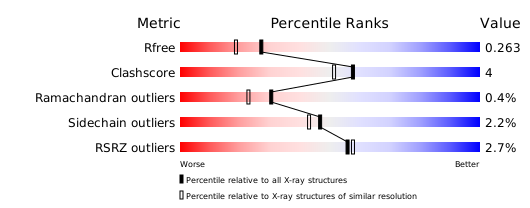
検証レポート(詳細版) をダウンロード
をダウンロード


