






 9Q1B
9Q1B
MS2 bacteriophage coat protein after reassembly as a nanocrate (MS2nc) with no cargo and with waters modeled
9Q1B の概要
| エントリーDOI | 10.2210/pdb9q1b/pdb |
| EMDBエントリー | 72122 |
| 分子名称 | Capsid protein (2 entities in total) |
| 機能のキーワード | bacteriophage, vlp, ms2, nanocrate, virus |
| 由来する生物種 | Escherichia phage MS2 |
| タンパク質・核酸の鎖数 | 3 |
| 化学式量合計 | 41215.39 |
| 構造登録者 | Zimanyi, C.M.,Bobe, D.,Jenkins, M.C.,Kopylov, M. (登録日: 2025-08-13, 公開日: 2025-08-27, 最終更新日: 2026-03-11) |
| 主引用文献 | Jenkins, M.C.,Bobe, D.,Johnston, J.D.,Cheung, J.,Karasawa, A.,Zimanyi, C.M.,Dermanci, O.,Finn, M.G.,de Marco, A.,Kopylov, M. Overcoming air-water interface-induced artifacts in Cryo-EM with protein nanocrates. Biorxiv, 2025 Cited by PubMed Abstract: Contact with the air-water interface can bias the orientation of macromolecules during cryo-EM sample preparation, leading to uneven sample distribution, preferred orientation, and damage to the molecules of interest. To prevent this, we describe a method to encapsulate target proteins within highly hydrophilic, structurally homogeneous, and stable protein shells, which we refer to as "nanocrates" for this purpose. Here, we describe packaging, data acquisition, and reconstruction of three proof-of-principle examples, each illuminating a different aspect of the method: apoferritin (ApoF, demonstrating high-resolution), thyroglobulin (Tg, solving a known preferred orientation problem), and 7,8-dihydroneopterin aldolase (DHNA, a structure previously uncharacterized by cryo-EM). PubMed: 40894667DOI: 10.1101/2025.08.18.667046 主引用文献が同じPDBエントリー |
| 実験手法 | ELECTRON MICROSCOPY (1.74 Å) |
構造検証レポート
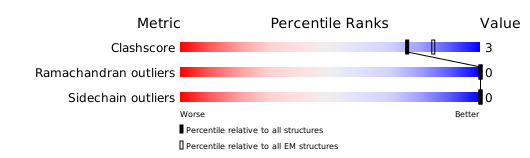
検証レポート(詳細版) をダウンロード
をダウンロード


