






 9PGF
9PGF9PGF の概要
| エントリーDOI | 10.2210/pdb9pgf/pdb |
| EMDBエントリー | 71630 |
| 分子名称 | 39S ribosomal protein L32, mitochondrial, 39S ribosomal protein L41, mitochondrial, GUANOSINE-5'-DIPHOSPHATE, ... (100 entities in total) |
| 機能のキーワード | mitochondria, mitoribosome, inner membrane, ribosome |
| 由来する生物種 | Homo sapiens (human) 詳細 |
| タンパク質・核酸の鎖数 | 91 |
| 化学式量合計 | 3076886.49 |
| 構造登録者 | |
| 主引用文献 | Wang, S.,Brischigliaro, M.,Zhang, Y.,Wu, C.,Zheng, W.,Barrientos, A.,Xiong, Y. Structural basis of TACO1-mediated efficient mitochondrial translation. Nat Commun, 17:-, 2026 Cited by PubMed Abstract: Translation elongation is a universally conserved step in protein synthesis, relying on elongation factors that engage the ribosomal L7/L12 stalk to mediate aminoacyl-tRNA delivery, accommodation, and ribosomal translocation. Using in organello cryo-electron microscopy, we reveal how the mitochondrial translation accelerator TACO1 promotes efficient elongation on human mitoribosomes. TACO1 binds the mitoribosomal region typically bound by elongation factor Tu (mtEF-Tu), bridging the large and small subunits via contacts with 16S rRNA, bL12m, A-site tRNA, and uS12m. While active throughout elongation, TACO1 is especially critical when translating polyproline motifs. Its absence prolongs mtEF-Tu residence in A/T states, causes persistent mitoribosomal stalling and premature subunit dissociation. Structural analyses indicate that TACO1 competes with mtEF-Tu for mitoribosome binding, stabilizes A-site tRNA, and enhances peptidyl transfer through a mechanism distinct from EF-P and eIF5A. These findings suggest that bacterial TACO1 orthologs may serve analogous roles, highlighting an evolutionarily conserved strategy for maintaining elongation efficiency during challenging translation events. PubMed: 41663403DOI: 10.1038/s41467-026-69156-y 主引用文献が同じPDBエントリー |
| 実験手法 | ELECTRON MICROSCOPY (2.93 Å) |
構造検証レポート
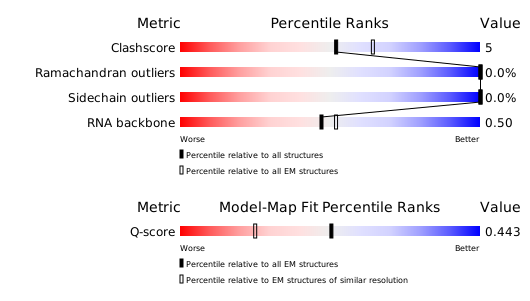
検証レポート(詳細版) をダウンロード
をダウンロード


