






 9PDN
9PDN
Nub1/Fat10-processing human 26S proteasome with Rpt1 at top of spiral staircase (AAA+ locally refined)
これはPDB形式変換不可エントリーです。
9PDN の概要
| エントリーDOI | 10.2210/pdb9pdn/pdb |
| EMDBエントリー | 71538 |
| 分子名称 | 26S protease regulatory subunit 8, Substrate polypeptide, 26S proteasome regulatory subunit 7, ... (19 entities in total) |
| 機能のキーワード | 26s proteasome, nub1, fat10, motor protein, hydrolase-protein binding complex |
| 由来する生物種 | Homo sapiens (human) 詳細 |
| タンパク質・核酸の鎖数 | 15 |
| 化学式量合計 | 530928.77 |
| 構造登録者 | |
| 主引用文献 | Arkinson, C.,Gee, C.L.,Zhang, Z.,Dong, K.C.,Martin, A. Structural landscape of the degrading 26S proteasome reveals conformation-specific binding of TXNL1. Nat.Struct.Mol.Biol., 32:2403-2415, 2025 Cited by PubMed Abstract: The 26S proteasome targets many cellular proteins for degradation during homeostasis and quality control. Proteasome-interacting cofactors modulate these functions and aid in substrate degradation. Here we solve high-resolution structures of the redox active cofactor TXNL1 bound to the human 26S proteasome at saturating and substoichiometric concentrations by time-resolved cryo-electron microscopy (cryo-EM). We identify distinct binding modes of TXNL1 that depend on the proteasome conformation and ATPase motor states. Together with biophysical and biochemical experiments, we show that the resting-state proteasome binds TXNL1 with low affinity and in variable positions on top of the Rpn11 deubiquitinase. In contrast, in the actively degrading proteasome, TXNL1 uses additional interactions for high-affinity binding, whereby its C-terminal tail covers the catalytic groove of Rpn11 and coordinates the active-site Zn. Furthermore, these cryo-EM structures of the degrading proteasome capture the ATPase hexamer in several spiral-staircase arrangements that indicate temporally asymmetric hydrolysis and conformational changes in bursts during mechanical substrate unfolding and translocation. Remarkably, we catch the proteasome in the act of unfolding the β-barrel mEos3.2 substrate while the ATPase hexamer is in a particular staircase register. Our findings advance current models for protein translocation through hexameric AAA+ motors and reveal how the proteasome uses its distinct conformational states to coordinate cofactor binding and substrate processing. PubMed: 41198955DOI: 10.1038/s41594-025-01695-2 主引用文献が同じPDBエントリー |
| 実験手法 | ELECTRON MICROSCOPY (3.04 Å) |
構造検証レポート
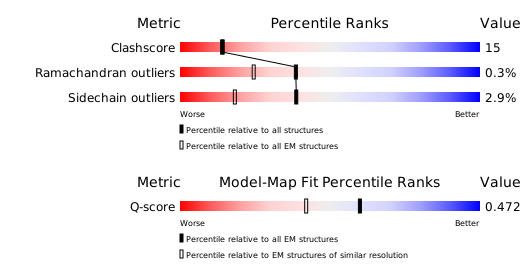
検証レポート(詳細版) をダウンロード
をダウンロード


