






 9OTH
9OTH
D3 prohead 1
9OTH の概要
| エントリーDOI | 10.2210/pdb9oth/pdb |
| 関連するPDBエントリー | 9OSB |
| EMDBエントリー | 70800 70832 |
| 分子名称 | Major capsid protein (1 entity in total) |
| 機能のキーワード | icosahedral symmetry, bacteriophage, procapsid, capsid, hk97 fold, virus like particle |
| 由来する生物種 | Pseudomonas phage D3 |
| タンパク質・核酸の鎖数 | 9 |
| 化学式量合計 | 385847.33 |
| 構造登録者 | |
| 主引用文献 | Belford, A.K.,Maurer, J.B.,Duda, R.L.,Huet, A.,Conway, J.F. Structural insights into scaffold-guided assembly of the Pseudomonas phage D3 capsid. Nat Commun, 16:11586-11586, 2025 Cited by PubMed Abstract: Tailed bacteriophages comprise the largest structural family of viruses with close relatives in archaea and the eukaryotic herpesviruses. The common assembly pathway produces an icosahedrally symmetric protein shell, called capsid, into which the double-stranded DNA genome is packaged. While capsid sizes and amino acid sequences vary considerably, the major capsid protein (MCP) folds are remarkably similar throughout the family. To investigate the mechanisms governing capsid size, we characterize the procapsid and mature capsid of phage D3, which expresses an icosahedral lattice with Triangulation number T = 9. We find that the MCP scaffold domain binds to the interior capsid surface, acting as a clamp to constrain subunit interactions. Following scaffold digestion, the MCP capsid domains form strong interactions that maintain capsid structure throughout maturation. The scaffold constraints appear critical for capsid size determination and provide important understanding of the factors governing capsid assembly in general and expands our understanding of these ecologically and biomedically important viruses. PubMed: 41274907DOI: 10.1038/s41467-025-66648-1 主引用文献が同じPDBエントリー |
| 実験手法 | ELECTRON MICROSCOPY (3.5 Å) |
構造検証レポート
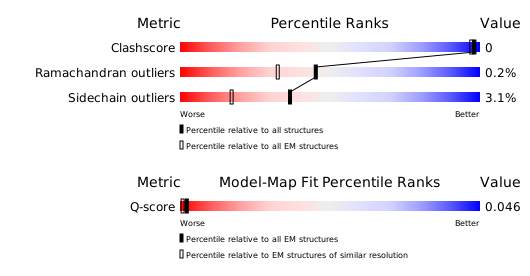
検証レポート(詳細版) をダウンロード
をダウンロード


