






 9OM3
9OM3
Two Component Protein Nano-Particle (T=3). De Novo Design, Computationally Relaxed into Low Resolution Single Particle CryoEM Map with Icosahedral Symmetry Applied
これはPDB形式変換不可エントリーです。
9OM3 の概要
| エントリーDOI | 10.2210/pdb9om3/pdb |
| EMDBエントリー | 70605 |
| 分子名称 | C2-B, C3-A (2 entities in total) |
| 機能のキーワード | goldberg icosahedron, c60, fullerene, de novo protein |
| 由来する生物種 | synthetic construct 詳細 |
| タンパク質・核酸の鎖数 | 360 |
| 化学式量合計 | 8275128.84 |
| 構造登録者 | |
| 主引用文献 | Wang, S.,Xie, Y.,Chemielewski, D.,Weidle, C.,Shu, T.,Ahn, G.,Kibler, R.D.,Hernandez, C.,Chen, W.,Duran, D.C.,Carr, A.,Bera, A.K.,Lee, S.,Decarreau, J.,Kang, A.,Brackenbrough, E.,Joyce, E.,Wu, K.,Borst, A.J.,Favor, A.,Huang, B.,DiMaio, F.,Holt, L.J.,Baker, D. De novo design of quasisymmetric two-component protein cages. Nature, 2026 Cited by PubMed Abstract: Quasisymmetric icosahedral viral capsids achieve larger sizes than possible with strictly symmetric icosahedra by tessellating pentagons and hexagons using a single subunit that adopts different conformations in symmetrically non-equivalent locations. Recapitulating such quasisymmetric architectures through computational design is a considerable challenge in nanomaterials engineering. Here we introduce a computational design strategy based on geometric frustration to generate two-component, quasisymmetric protein cages with customizable properties. We designed complementary trimeric and dimeric protein components that co-assemble into positively curved local hexagonal assemblies. Hexagonal lattices cannot tile spherical surfaces; instead, the components form closed sphere-like cage assemblies through incorporation of curvature-inducing pentagonal defects, as evidenced by electron microscopy. By designing dimers that encode different local curvatures, we programmed cage dimensions ranging from 40 to over 200 nm in diameter and with molecular weights from 2 MDa to over 50 MDa, comparable with natural virus capsids. We further functionalized these large cages with additional protein domains to enable ribonucleoprotein cargo loading and cellular uptake. Fluorescently labelled cage assemblies expressed in mammalian cells function as rheological probes and cargo recruiters, enabling a systematic study of size-dependent cytoplasmic diffusion and protein localization. Thus, the quasi-symmetry that has long fascinated structural biologists can now be achieved by computational protein design, with immediate applications to biologics delivery and molecular cell biology. PubMed: 42162421DOI: 10.1038/s41586-026-10464-0 主引用文献が同じPDBエントリー |
| 実験手法 | ELECTRON MICROSCOPY (17.45 Å) |
構造検証レポート
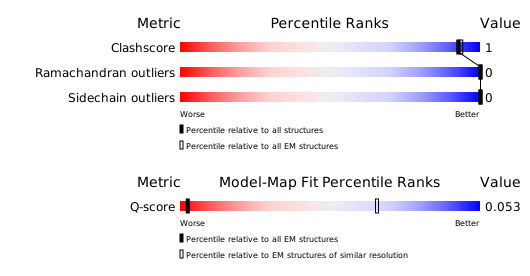
検証レポート(詳細版) をダウンロード
をダウンロード


