






9OGW
Identification of ligands for E3 ligases using fragment-based methods
This is a non-PDB format compatible entry.
Summary for 9OGW
| Entry DOI | 10.2210/pdb9ogw/pdb |
| Descriptor | E3 ubiquitin-protein ligase CBL-C, 2-{[(thiophen-3-yl)methyl]amino}benzoic acid (3 entities in total) |
| Functional Keywords | small molecule, complex crystal structure, cbl-c, tkb (tyrosine kinase binding), regulator of egfr mediated signal transduction, ligase |
| Biological source | Homo sapiens (human) |
| Total number of polymer chains | 1 |
| Total formula weight | 35695.93 |
| Authors | Phan, J.,Fesik, S.W. (deposition date: 2025-05-02, release date: 2025-10-22, Last modification date: 2025-11-05) |
| Primary citation | Waterson, A.G.,Lehmann, B.D.,Lu, Z.,Sensintaffar, J.L.,Olejniczak, E.T.,Zhao, B.,Rietz, T.,Payne, W.G.,Phan, J.,Fesik, S.W. Identification of ligands for E3 ligases with restricted expression using fragment-based methods. Rsc Chem Biol, 6:1797-1808, 2025 Cited by PubMed Abstract: Heterobifunctional molecules that induce targeted degradation have emerged as powerful tools in chemical biology, target validation, and drug discovery. Despite their promise, the field is constrained by the relative paucity of ligands available for E3 ligases. Expanding the ligand repertoire for E3 ligases and other components of ubiquitin-proteasome system could significantly broaden the scope of the targeted degradation field. In this study, we report the identification of ligands for non-essential E3 ligases that are preferentially expressed in cancer tissues relative to normal tissues. Using a protein-observed NMR-based fragment screen, an ideal technique for this purpose, we identified fragment ligands and characterized their binding modes by X-ray crystallography. These ligands represent promising starting points for further optimization toward the discovery of tumor-selective degraders that may enhance the therapeutic window targeting proteins for which inhibition or degradation is associated with systemic toxicity. PubMed: 41070186DOI: 10.1039/d5cb00198f PDB entries with the same primary citation |
| Experimental method | X-RAY DIFFRACTION (1.8 Å) |
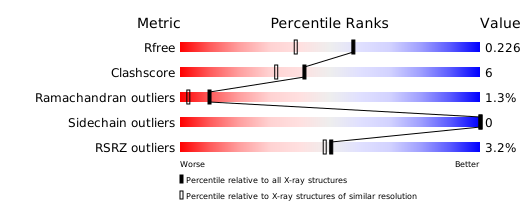
Structure validation
Download full validation report


