






 9OBY
9OBY
Ca2+-bound GluN1a/2B NMDAR (S1)
9OBY の概要
| エントリーDOI | 10.2210/pdb9oby/pdb |
| EMDBエントリー | 70303 |
| 分子名称 | Glutamate receptor ionotropic, NMDA 1, Glutamate receptor ionotropic, NMDA 2B, CALCIUM ION, ... (4 entities in total) |
| 機能のキーワード | membrane protein, ion channels, nmdar |
| 由来する生物種 | Rattus norvegicus (Norway rat) 詳細 |
| タンパク質・核酸の鎖数 | 4 |
| 化学式量合計 | 383489.80 |
| 構造登録者 | |
| 主引用文献 | Steigerwald, R.,Epstein, M.,Chou, T.H.,Simorowski, N.,Furukawa, H. Molecular mechanism of calcium permeability and magnesium block in NMDA receptors. Nat.Neurosci., 29:1293-1302, 2026 Cited by PubMed Abstract: Hebbian neuroplasticity, which is thought to be a cellular substrate of learning and memory, can occur by means of coincidental detection of presynaptic neurotransmitter release and Ca influx upon postsynaptic depolarization. This is mediated at a molecular level by N-methyl-D-aspartate-type glutamate receptors, which bind glutamate and glycine and facilitate Ca influx upon relief of Mg channel block during membrane depolarization. However, the structural mechanism underlying Ca permeability and Mg blockade in N-methyl-D-aspartate-type glutamate receptors has yet to be fully elucidated. Here we demonstrate using single-particle cryo-electron microscopy that Ca permeation through the narrow constriction of the cation selectivity filter involves partial dehydration, as evidenced by several Ca binding sites. In contrast, Mg binds outside of the selectivity filter through a water network and remains hydrated, thereby acting as a channel blocker. Furthermore, the lipid network around the selectivity filter influences the stability of Mg binding in a voltage-dependent manner. Our study details the transmembrane chemistry essential for initiating neuroplasticity. PubMed: 42086762DOI: 10.1038/s41593-026-02283-3 主引用文献が同じPDBエントリー |
| 実験手法 | ELECTRON MICROSCOPY (3.6 Å) |
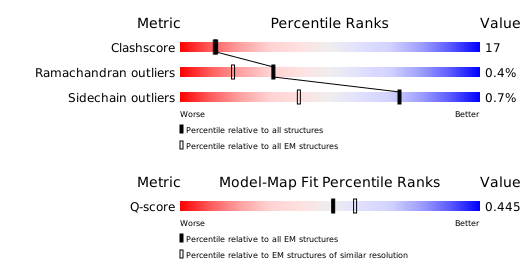
構造検証レポート
検証レポート(詳細版) をダウンロード
をダウンロード


