






 9O7L
9O7L9O7L の概要
| エントリーDOI | 10.2210/pdb9o7l/pdb |
| EMDBエントリー | 70203 |
| 分子名称 | pi-conjugated peptide, 2,2'-[thiophene-2,5-diyldi(4,1-phenylene)]diacetic acid (2 entities in total) |
| 機能のキーワード | peptide fiber, helical polymer, protein fibril |
| 由来する生物種 | synthetic construct |
| タンパク質・核酸の鎖数 | 6 |
| 化学式量合計 | 3898.33 |
| 構造登録者 | Rich-New, S.T.,Wang, R.,Zia, A.,Tovar, J.D.,Wang, F. (登録日: 2025-04-15, 公開日: 2025-07-30, 最終更新日: 2025-09-03) |
| 主引用文献 | Rich-New, S.T.,Wang, R.,Zia, A.,Wang, F.,Tovar, J.D. Cryo-EM Visualization of Intermolecular pi-Electron Interactions within pi-Conjugated Peptidic Supramolecular Polymers. ACS Macro Lett, 14:1100-1106, 2025 Cited by PubMed Abstract: The self-assembly of "π-peptides" - molecules with π-electron cores substituted with two or more oligopeptide chains - brings organic electronic function into biologically relevant nanomaterials. π-Peptides assemble into fibrillar nanomaterials as driven by enthalpic peptide-based hydrogen bonding networks and pi-core-based quadrupolar interactions. A large body of spectroscopic, morphological and computational studies informs on the nature of the self-assembly process and the resulting nanostructures, but detailed structural information has remained elusive. Inspired by the recent use of cryogenic electron microscopy (cryo-EM) to provide high-resolution structures for synthetic peptide nanomaterials, we present here the use of cryo-EM to offer ca. 3 Å resolution of π-peptide nanomaterial assemblies, visualizing for the first time the nature of the intermolecular π-core electronic interactions responsible for energy transport through these supramolecular materials. PubMed: 40686463DOI: 10.1021/acsmacrolett.5c00360 主引用文献が同じPDBエントリー |
| 実験手法 | ELECTRON MICROSCOPY (3.2 Å) |
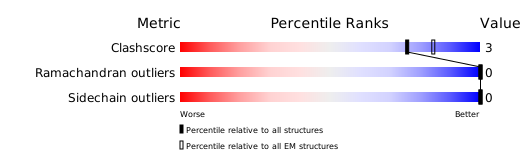
構造検証レポート
検証レポート(詳細版) をダウンロード
をダウンロード


