






 9O55
9O55
Structure of a synthetic antibody (RM010) in complex with a class I MHC presenting a hapten-peptide conjugate
これはPDB形式変換不可エントリーです。
9O55 の概要
| エントリーDOI | 10.2210/pdb9o55/pdb |
| EMDBエントリー | 70124 |
| 分子名称 | MHC class I antigen, GTPase KRas, N-terminally processed, RM010 Fab heavy chain, ... (5 entities in total) |
| 機能のキーワード | complex, fab, immune system |
| 由来する生物種 | Homo sapiens (human) 詳細 |
| タンパク質・核酸の鎖数 | 4 |
| 化学式量合計 | 46923.38 |
| 構造登録者 | |
| 主引用文献 | Maso, L.,Rajak, E.,Hattori, T.,Hu, Z.,Koide, A.,Neel, B.G.,Koide, S. Generation of actionable, cancer-specific neoantigens from KRAS(G12C) with adagrasib. Proc.Natl.Acad.Sci.USA, 122:e2509012122-e2509012122, 2025 Cited by PubMed Abstract: Effective immune therapy against cancer ideally should target a cancer-specific antigen, an antigen that is present exclusively in cancer cells. However, there is a paucity of cancer-specific antigens that are endogenously produced. HapImmune™ technology utilizes covalent inhibitors directed to an intracellular cancer driver to create cancer-specific neoantigens in the form of drug-peptide conjugates presented by class I MHC molecules. Our previous study with sotorasib, an FDA-approved covalent inhibitor of KRAS(G12C), demonstrated that drug-treated cells produce such neoantigens and can be killed by T cell engagers directed against the drug-peptide/MHC complex. Thus, this technology can unite targeted and immune therapies. In the present study, we examined whether this approach could generalize to another FDA-approved KRAS(G12C) inhibitor, adagrasib, whose chemical structure and cysteine reactivity differ substantially from sotorasib. We developed antibodies selective to adagrasib-KRAS(G12C) peptides presented by HLA-A*03 and A*11 that also show cross-reactivity to other KRAS(G12C) inhibitors presented in the same manner. Cryoelectron microscopy structures revealed a mode of adagrasib-peptide/HLA recognition distinctly different from that of sotorasib-directed HapImmune antibodies. The antibodies in a bispecific T cell engager format killed adagrasib-resistant lung cancer cells upon adagrasib treatment. These results support the broad applicability of the HapImmune approach for creating actionable cancer-specific neoantigens and offer candidates for therapeutic development. PubMed: 40737322DOI: 10.1073/pnas.2509012122 主引用文献が同じPDBエントリー |
| 実験手法 | ELECTRON MICROSCOPY (2.88 Å) |
構造検証レポート
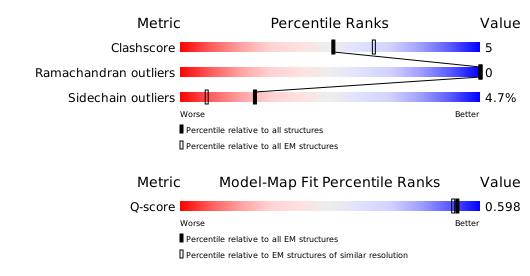
検証レポート(詳細版) をダウンロード
をダウンロード


