






 9NY1
9NY1
LmuA_conformation 2_assymetric
9NY1 の概要
| エントリーDOI | 10.2210/pdb9ny1/pdb |
| EMDBエントリー | 49915 |
| 分子名称 | ABC-three component systems C-terminal domain-containing protein (1 entity in total) |
| 機能のキーワード | lmua_asymmetric, dna binding protein |
| 由来する生物種 | Vibrio cholerae |
| タンパク質・核酸の鎖数 | 4 |
| 化学式量合計 | 178106.47 |
| 構造登録者 | |
| 主引用文献 | Haudiquet, M.,Chakravarti, A.,Zhang, Z.,Ramirez, J.L.,Herrero Del Valle, A.,Olinares, P.D.B.,Lavenir, R.,Ahmed, M.A.,de la Cruz, M.J.,Chait, B.T.,Sternberg, S.H.,Bernheim, A.,Patel, D.J. Structural basis for Lamassu-based antiviral immunity and its evolution from DNA repair machinery. Proc.Natl.Acad.Sci.USA, 122:e2519643122-e2519643122, 2025 Cited by PubMed Abstract: Bacterial immune systems exhibit remarkable diversity and modularity, as a consequence of the continuous selective pressures imposed by phage predation. Despite recent mechanistic advances, the evolutionary origins of many antiphage immune systems remain elusive, especially for those that encode homologs of the structural maintenance of chromosomes (SMC) superfamily, which are essential for chromosome maintenance and DNA repair across domains of life. Here, we elucidate the structural basis and evolutionary emergence of Lamassu, a bacterial immune system family featuring diverse effectors but a core conserved SMC-like sensor. Using cryo-EM, we determined structures of the Lamassu complex in both apo- and dsDNA-bound states, revealing unexpected stoichiometry and topological architectures. We further demonstrate how Lamassu specifically senses dsDNA ends in vitro and phage replication origins in vivo, thereby triggering the formation of LmuA tetramers that activate its Cap4 nuclease domain. Our findings reveal that Lamassu evolved via exaptation of the bacterial Rad50-Mre11 DNA repair system to form a compact, modular sensor for viral replication, exemplifying how cellular machinery can be co-opted for novel immune functions. PubMed: 41252147DOI: 10.1073/pnas.2519643122 主引用文献が同じPDBエントリー |
| 実験手法 | ELECTRON MICROSCOPY (3.4 Å) |
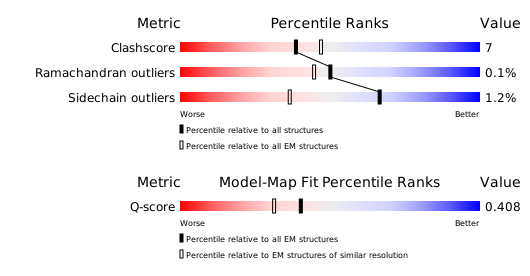
構造検証レポート
検証レポート(詳細版) をダウンロード
をダウンロード


