






 9NPJ
9NPJ
Structural studies of reaction hijacking inhibition of a malaria parasite aspartyl-tRNA synthetase.
これはPDB形式変換不可エントリーです。
9NPJ の概要
| エントリーDOI | 10.2210/pdb9npj/pdb |
| 分子名称 | aspartate--tRNA ligase, 9-(5-O-{[(1R,2R)-2-amino-3-carboxy-1-hydroxypropyl]sulfamoyl}-beta-D-lyxofuranosyl)-2-chloro-9H-purin-6-amine, GLYCEROL, ... (4 entities in total) |
| 機能のキーワード | t-rna synthetase, malaria, inhibitor, ligase |
| 由来する生物種 | Plasmodium vivax (malaria parasite P. vivax) |
| タンパク質・核酸の鎖数 | 2 |
| 化学式量合計 | 125437.55 |
| 構造登録者 | Khandokar, Y.,Ketprasit, K.,Tai, C.W.,Xie, S.,Tilley, L.,Griffin, M.D.W.,Panjikar, S. (登録日: 2025-03-11, 公開日: 2025-06-04, 最終更新日: 2025-07-23) |
| 主引用文献 | Ketprasit, N.,Tai, C.W.,Sharma, V.K.,Manickam, Y.,Khandokar, Y.,Ye, X.,Dogovski, C.,Hilko, D.H.,Morton, C.J.,Braun, A.C.,Leeming, M.G.,Siddharam, B.,Shami, G.J.,Pradeepkumar, P.I.,Panjikar, S.,Poulsen, S.A.,Griffin, M.D.W.,Sharma, A.,Tilley, L.,Xie, S.C. Natural product-mediated reaction hijacking mechanism validates Plasmodium aspartyl-tRNA synthetase as an antimalarial drug target. Plos Pathog., 21:e1013057-e1013057, 2025 Cited by PubMed Abstract: Malaria poses an enormous threat to human health. With ever-increasing resistance to currently deployed antimalarials, new targets and starting point compounds with novel mechanisms of action need to be identified. Here, we explore the antimalarial activity of the Streptomyces sp natural product, 5'-O-sulfamoyl-2-chloroadenosine (dealanylascamycin, DACM) and compare it with the synthetic adenosine monophosphate (AMP) mimic, 5-O-sulfamoyladenosine (AMS). These nucleoside sulfamates exhibit potent inhibition of P. falciparum growth with an efficacy comparable to that of the current front-line antimalarial, dihydroartemisinin. Exposure of P. falciparum to DACM leads to inhibition of protein translation, driven by eIF2α phosphorylation. We show that DACM targets multiple aminoacyl-tRNA synthetases (aaRSs), including the cytoplasmic aspartyl tRNA synthetase (AspRS). The mechanism involves hijacking of the reaction product, leading to the formation of a tightly bound inhibitory amino acid-sulfamate conjugate. We show that recombinant P. falciparum and P. vivax AspRS are susceptible to hijacking by DACM and AMS, generating Asp-DACM and Asp-AMS adducts that stabilize these proteins. By contrast, human AspRS appears less susceptible to hijacking. X-ray crystallography reveals that apo P. vivax AspRS exhibits a stabilized flipping loop over the active site that is poised to bind substrates. By contrast, human AspRS exhibits disorder in an extended region around the flexible flipping loop as well as in a loop in motif II. These structural differences may underpin the decreased susceptibility of human AspRS to reaction-hijacking by DACM and AMS. Our work reveals Plasmodium AspRS as a promising antimalarial target and highlights structural features that underpin differences in the susceptibility of aaRSs to reaction hijacking inhibition. PubMed: 40627786DOI: 10.1371/journal.ppat.1013057 主引用文献が同じPDBエントリー |
| 実験手法 | X-RAY DIFFRACTION (2.36 Å) |
構造検証レポート
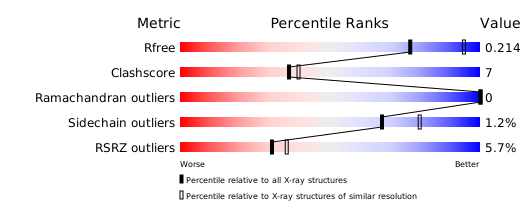
検証レポート(詳細版) をダウンロード
をダウンロード


