






9NKF
Structure of human substrate-free 26S proteasome in the presence of ATPgS and MG-132,SA-like state (composite map)
これはPDB形式変換不可エントリーです。
9NKF の概要
| エントリーDOI | 10.2210/pdb9nkf/pdb |
| EMDBエントリー | 49507 |
| 分子名称 | 26S proteasome regulatory subunit 7, Proteasome subunit alpha type-5, Proteasome subunit alpha type-1, ... (37 entities in total) |
| 機能のキーワード | apo state, proteasome, midnolin, substrate-free 26s, mg-132, immune system |
| 由来する生物種 | Homo sapiens (human) 詳細 |
| タンパク質・核酸の鎖数 | 46 |
| 化学式量合計 | 1670602.65 |
| 構造登録者 | |
| 主引用文献 | Peddada, N.,Zhong, X.,Yin, Y.,Lazaro, D.R.,Wang, J.,Lyon, S.,Choi, J.H.,Bai, X.C.,Moresco, E.M.Y.,Beutler, B. Structural insights into the ubiquitin-independent midnolin-proteasome pathway. Proc.Natl.Acad.Sci.USA, 122:e2505345122-e2505345122, 2025 Cited by PubMed Abstract: The protein midnolin (MIDN) augments proteasome activity in lymphocytes and dramatically facilitates the survival and proliferation of B-lymphoid malignancies. MIDN binds both to proteasomes and to substrates, but the mode of interaction with the proteasome is unknown, and the mechanism by which MIDN facilitates substrate degradation in a ubiquitin-independent manner is incompletely understood. Here, we present cryoelectron microscopy (cryo-EM) structures of the substrate-engaged, MIDN-bound human proteasome in two conformational states. MIDN induces proteasome conformations similarly to ubiquitinated substrates by using its ubiquitin-like domain to bind to the deubiquitinase RPN11 (PSMD14). By simultaneously binding to RPN1 (PSMD2) with its C-terminal α-helix, MIDN positions its substrate-carrying Catch domain above the proteasome ATPase channel through which substrates are translocated before degradation. Our findings suggest that both ubiquitin-like domain and C-terminal α-helix must bind to the proteasome for MIDN to stimulate proteasome activity. PubMed: 40339123DOI: 10.1073/pnas.2505345122 主引用文献が同じPDBエントリー |
| 実験手法 | ELECTRON MICROSCOPY (2.9 Å) |
構造検証レポート
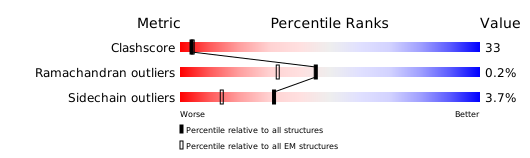
検証レポート(詳細版) をダウンロード
をダウンロード


