






 9NIL
9NIL
Structure of a Y1216F mutant of the acyltransferase domain of NcdE, a multi-domain NRPS protein from nocardichelin biosynthesis
9NIL の概要
| エントリーDOI | 10.2210/pdb9nil/pdb |
| 関連するPDBエントリー | 9NIJ |
| 分子名称 | NcdE, 4-(2-HYDROXYETHYL)-1-PIPERAZINE ETHANESULFONIC ACID (3 entities in total) |
| 機能のキーワード | acyltransferase, gnat, siderophore biosynthesis, nrps independent siderophores, ncde-atx, transferase |
| 由来する生物種 | Nocardia carnea |
| タンパク質・核酸の鎖数 | 1 |
| 化学式量合計 | 22720.52 |
| 構造登録者 | |
| 主引用文献 | Fisk, M.B.,Barrera Ramirez, J.,Merrick, C.E.,Wencewicz, T.A.,Gulick, A.M. Identification and Characterization of the Biosynthesis of the Hybrid NRPS-NIS Siderophore Nocardichelin. Acs Chem.Biol., 20:1435-1446, 2025 Cited by PubMed Abstract: Bacteria cope with the limitation of iron by producing siderophores, small molecules they export that have high affinity for iron. Once complexed, the ferric siderophore is transported into the cell through specialized receptors allowing the iron to be released and used in a variety of biological processes. Many peptide siderophores that use catechol, phenolate, or oxazoline/thiazoline groups to coordinate iron are produced by a family of enzymes called nonribosomal peptide synthetases (NRPSs). Alternately, a smaller family of NRPS-independent siderophores (NISs) is produced by a different biosynthetic strategy. The NIS pathways employ one or more NIS synthetases that combine an amine commonly harboring a hydroxamate with a carboxylate substrate. Discovered in 2007 in an uncharacterized species, a siderophore called nocardichelin was identified and chemically characterized that contained features of both NIS and NRPS siderophores. Nocardichelin contains an -salicyloxazoline moiety, predicted to be built by a modular NRPS, and a dihydroxamate containing -hydroxy--succinylcadaverine and -hydroxy--tetradecenoylcadaverine groups. To explore this potential hybrid NRPS/NIS, we identified a biosynthetic gene cluster in containing 13 enzymes and four proteins involved in transport. We have functionally characterized four of the enzymes for their activity and substrate specificity and further solved the structures of two enzymes. We present our discovery and initial characterization of this cluster, describe remaining questions for elucidation of the unusual siderophore, and discuss the potential for use in downstream biocatalytic applications. PubMed: 40479602DOI: 10.1021/acschembio.5c00286 主引用文献が同じPDBエントリー |
| 実験手法 | X-RAY DIFFRACTION (1.44 Å) |
構造検証レポート
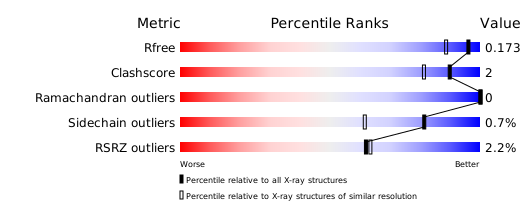
検証レポート(詳細版) をダウンロード
をダウンロード


