






 9N4H
9N4H
YehD receptor binding domain S49A
9N4H の概要
| エントリーDOI | 10.2210/pdb9n4h/pdb |
| 分子名称 | YehD protein, GLYCEROL, FORMIC ACID, ... (5 entities in total) |
| 機能のキーワード | adhesin, cup pili, cell adhesion |
| 由来する生物種 | Escherichia coli |
| タンパク質・核酸の鎖数 | 2 |
| 化学式量合計 | 36618.64 |
| 構造登録者 | |
| 主引用文献 | Tamadonfar, K.O.,Klein, R.D.,Lopatto, E.D.B.,Zimmerman, M.I.,Azimzadeh, P.N.,Sanick, D.A.,Porter, J.R.,Villicana, J.B.,Pinkner, J.S.,Chiang, B.H.,Gualberto, N.C.,Dodson, K.W.,Patnode, M.L.,Birchenough, G.M.H.,Bowman, G.R.,Hultgren, S.J. The Yeh pilus adhesin is equipped with an alpha-helical flap motif, which contributes to pectin adherence. Sci Adv, 12:eadz1301-eadz1301, 2026 Cited by PubMed Abstract: The Yeh chaperone-usher pathway (CUP) pilus adhesin is encoded in one-half of all . Yet little is known about its structure and function in persistence and pathogenesis. Structural investigations reveal that the adhesin receptor binding domains (RBDs) of YehD and its relative YhlD both share a canonical β-rich core and an α-helical flap motif that is hinged at the distal end of the core. This flap was observed in both open and closed conformations using molecular dynamics simulations. The closed conformation is dependent on a hydrophobic patch of amino acids on the distal end of the flap. Functionally, YehD is able to bind pectin, a polysaccharide ubiquitous in plant material. Mutations that interrupt the closed conformation increase the affinity of the protein to pectin, suggesting that the flap contributes mechanistically to pectin binding. Furthermore, in vivo, the pilus contributes to gastrointestinal (GI) tract colonization in the absence of the type 1 pilus. Hence, we report the ability of YehD to bind pectin representing a possible colonization mechanism of the GI tract via a structurally distinct CUP adhesin. PubMed: 41499512DOI: 10.1126/sciadv.adz1301 主引用文献が同じPDBエントリー |
| 実験手法 | X-RAY DIFFRACTION (1.65 Å) |
構造検証レポート
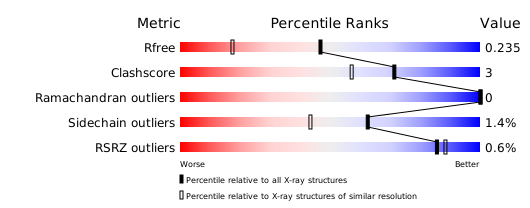
検証レポート(詳細版) をダウンロード
をダウンロード


