






 9MXW
9MXW
Computationally Designed protein with isopeptide bond dnIPB-1
9MXW の概要
| エントリーDOI | 10.2210/pdb9mxw/pdb |
| 分子名称 | de novo protein with intramolecular isopeptide bond dnIPB-1, SULFATE ION (3 entities in total) |
| 機能のキーワード | isopeptide, computational design, de novo protein |
| 由来する生物種 | synthetic construct |
| タンパク質・核酸の鎖数 | 3 |
| 化学式量合計 | 33925.63 |
| 構造登録者 | |
| 主引用文献 | Srisantitham, S.,Walker, A.L.,Markel, U.,Tezcan, F.A. De Novo Design of Proteins for Autocatalytic Isopeptide Bond Formation. J.Am.Chem.Soc., 147:12338-12346, 2025 Cited by PubMed Abstract: Isopeptide bonds (IPBs)─formed between the amine group of a Lys residue and the carboxamide/carboxy group of Asn/Gln or Asp/Glu─play essential roles in many biological processes, ranging from cellular signaling and regulation to blood clotting and bacterial pathogenesis. The formation of IPBs is not a spontaneous process and requires enzymatic machinery that provides a specialized active site environment to enable this challenging catalytic reaction. Here we report the de novo design and characterization of two proteins (dnIPB-1 and dnIPB-2) capable of autocatalytic IPB formation. While these designed proteins preserve the key active-site residues of their structural template (the bacterial pilin protein RrgA), they possess less than 31% sequence identity to RrgA. Extensive structural and Ala-scanning analyses indicate that IPB formation requires a solvent-protected core motif composed of several critical residues, yet there is also a large tolerance to different protein topologies and overall protein sizes in terms of accommodating an IPB-forming motif. Notably, the structural insights gained from the study of dnIPB-1 and dnIPB-2 also guided the redesign of an initially failed construct (dnIPB-3) and enabled it to form an IPB, highlighting the value of de novo design in examining sequence-structure-function relationships not explored in natural evolution. Our study highlights the versatility of IPBs as designable elements which can be used to construct functional proteins or protein-based materials with enhanced chemical, thermal, and mechanical stabilities. PubMed: 40138671DOI: 10.1021/jacs.5c03319 主引用文献が同じPDBエントリー |
| 実験手法 | X-RAY DIFFRACTION (2.87 Å) |
構造検証レポート
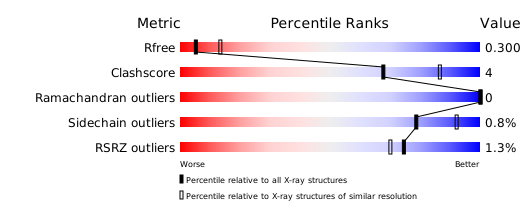
検証レポート(詳細版) をダウンロード
をダウンロード


