






 9MUT
9MUT
Reduced state of a turn-on thiol-disulfide redox biosensor with a fluorescence-lifetime readout
9MUT の概要
| エントリーDOI | 10.2210/pdb9mut/pdb |
| 分子名称 | Fluorescent thiol-disulfide redox biosensor, 1,2-ETHANEDIOL, ACETATE ION, ... (7 entities in total) |
| 機能のキーワード | fluorescence lifetime, thiol-disulfide redox, fluorescent protein |
| 由来する生物種 | Aequorea victoria |
| タンパク質・核酸の鎖数 | 2 |
| 化学式量合計 | 57654.89 |
| 構造登録者 | |
| 主引用文献 | Rosen, P.C.,Glaser, A.,Martinez-Francois, J.R.,Lim, D.C.,Brooks, D.J.,Fu, P.,Kim, E.,Kern, D.,Yellen, G. Mechanism and application of thiol-disulfide redox biosensors with a fluorescence-lifetime readout. Proc.Natl.Acad.Sci.USA, 122:e2503978122-e2503978122, 2025 Cited by PubMed Abstract: Genetically encoded biosensors with changes in fluorescence lifetime (as opposed to fluorescence intensity) can quantify small molecules in complex contexts, even in vivo. However, lifetime-readout sensors are poorly understood at a molecular level, complicating their development. Although there are many sensors that have fluorescence-intensity changes, there are currently only a few with fluorescence-lifetime changes. Here, we optimized two biosensors for thiol-disulfide redox (RoTq-Off and RoTq-On) with opposite changes in fluorescence lifetime in response to oxidation. Using biophysical approaches, we showed that the high-lifetime states of these sensors lock the chromophore more firmly in place than their low-lifetime states do. Two-photon fluorescence lifetime imaging of RoTq-On fused to a glutaredoxin (Grx1) enabled robust, straightforward monitoring of cytosolic glutathione redox state in acute mouse brain slices. The motional mechanism described here is probably common and may inform the design of other lifetime-readout sensors; the Grx1-RoTq-On fusion sensor will be useful for studying glutathione redox in physiology. PubMed: 40327692DOI: 10.1073/pnas.2503978122 主引用文献が同じPDBエントリー |
| 実験手法 | X-RAY DIFFRACTION (2.2 Å) |
構造検証レポート
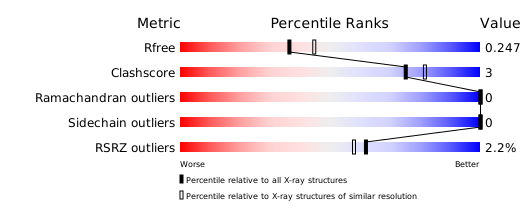
検証レポート(詳細版) をダウンロード
をダウンロード


