






 9MS3
9MS3
Crystal structure of Bmp7 in complex with 2,4-dibromophenol generated by substrate soaking
9MS3 の概要
| エントリーDOI | 10.2210/pdb9ms3/pdb |
| 分子名称 | Polybrominated aromatic compounds synthase, GLYCEROL, CHLORIDE ION, ... (6 entities in total) |
| 機能のキーワード | cytochrome p450 enzyme, biaryl coupling, oxidoreductase |
| 由来する生物種 | Marinomonas mediterranea |
| タンパク質・核酸の鎖数 | 1 |
| 化学式量合計 | 58138.09 |
| 構造登録者 | |
| 主引用文献 | Petriti, V.,Nolan, K.,Xu, W.,Tsai, S.,Wang, X.,Xie, W.J.,Zheng, G.,Wang, Y.,Ding, Y. Bacterial cytochrome P450 for oxidative halogenated biaryl coupling. Acs Catalysis, 16:2615-2627, 2026 Cited by PubMed Abstract: Biaryl motifs are fundamental structural elements in many pharmaceuticals, agrochemicals, and advanced materials. Traditional synthetic approaches for biaryl bond formation often require harsh conditions, costly catalysts, and pre-functionalized starting materials, which limit their efficiency, sustainability, and substrate scope. Enzymatic catalysis offers a greener alternative. However, biocatalysts capable of directly coupling halogenated biaryl compounds remain largely underexplored. Here, we report the functional characterization of the marine-derived cytochrome P450 enzyme Bmp7, which catalyzes the formation of halogenated biaryls. We first characterized the product profile of recombinant Bmp7 using its native substrate 2,4-dibromophenol () and confirmed the dominant - C-C homocoupled product as MC21-A. Screening a halogenated aromatic substrate library revealed that Bmp7 binds and catalyzes the coupling of 17 halogenated phenols, as evidenced by spectral shift assays, LC-HRMS, HRMS/MS and GC-MS analyses. Two homocoupled products were structurally confirmed by NMR analysis to possess C-C linkages. In addition to efficient homocoupling, Bmp7 catalyzed heterocoupling reactions between substrate and 16 other substrates, producing mixtures of homocoupled and heterocoupled halogenated biphenols. X-ray crystallography revealed the binding of two substrate molecules within the active site, while DFT calculations supported a single-radical reaction mechanism, shedding light on the mechanistic basis of the coupling reaction. Together, these findings lay the groundwork for these findings establish a foundation for future efforts in enzyme engineering and the development of biocatalytic strategies for synthetic applications. PubMed: 41789186DOI: 10.1021/acscatal.5c08060 主引用文献が同じPDBエントリー |
| 実験手法 | X-RAY DIFFRACTION (2.25 Å) |
構造検証レポート
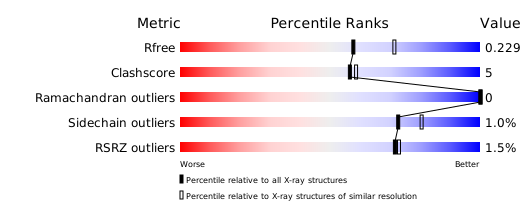
検証レポート(詳細版) をダウンロード
をダウンロード


