






 9M5D
9M5D
Crystal structure of S. aureus protein A bound to a human single-domain antibody
9M5D の概要
| エントリーDOI | 10.2210/pdb9m5d/pdb |
| 分子名称 | n501, Immunoglobulin G-binding protein A (2 entities in total) |
| 機能のキーワード | complex, antibody, s. aureus, immune system |
| 由来する生物種 | Homo sapiens 詳細 |
| タンパク質・核酸の鎖数 | 4 |
| 化学式量合計 | 40049.92 |
| 構造登録者 | |
| 主引用文献 | Kong, Y.,Shi, J.,Wu, F.,Zhao, T.,Wang, R.,Zhu, X.,Xu, Q.,Song, Y.,Li, Q.,Wang, Y.,Gao, X.,Yang, Y.,Feng, Y.,Wang, Z.,Ge, W.,Wu, Y.,Yang, Z.,Yao, J.,Ying, T. A synergistic generative-ranking framework for tailored design of therapeutic single-domain antibodies. Cell Discov, 11:85-85, 2025 Cited by PubMed Abstract: Single-domain antibodies (sdAbs) have emerged as powerful therapeutic agents due to their small size, high stability, and superior tissue penetration. However, unlike conventional monoclonal antibodies (mAbs), sdAbs lack an Fc domain, limiting their functional versatility and manufacturability. To address this challenge, we developed TFDesign-sdAb, a deep learning-based generative-ranking framework that enables rational engineering of sdAbs with tailored functionalities. Our framework integrates a structure-aware diffusion model (IgGM) for large-scale candidate generation and a fine-tuned sorter (A2binder) that evaluates and prioritizes them based on predicted functionality. Unlike traditional CDR-focused approaches, TFDesign-sdAb optimizes both complementarity-determining regions (CDRs) and framework regions (FRs), allowing sdAbs to acquire new functional properties while maintaining antigen specificity. We validated our approach by conferring Protein A binding to human VHs and nanobodies that originally lacked this feature, achieving high expression rates, strong binding affinities, and successful purification via industry-standard Protein A affinity chromatography. High-resolution structural characterization (1.49 Å and 2.0 Å) of the redesigned sdAb-Protein A complexes revealed conserved FR-mediated binding motifs that recapitulate natural Fc-Protein A interactions, validating the accuracy of our model. Furthermore, our pipeline streamlined the antibody engineering process, achieving a 100% success rate in generating Protein A-binding sdAbs while maintaining their original antigen-binding affinity. This work demonstrates the power of AI-driven design in overcoming long-standing limitations in antibody engineering and presents a scalable, generalizable solution for enhancing sdAb functionality. PubMed: 41162386DOI: 10.1038/s41421-025-00843-8 主引用文献が同じPDBエントリー |
| 実験手法 | X-RAY DIFFRACTION (3.57 Å) |
構造検証レポート
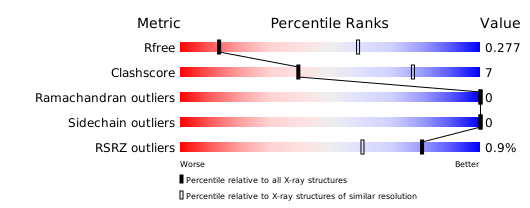
検証レポート(詳細版) をダウンロード
をダウンロード


