






9M3F
Cryo-EM structure of Rc-o319 RBD/R. cornutus ACE2 complex
9M3F の概要
| エントリーDOI | 10.2210/pdb9m3f/pdb |
| EMDBエントリー | 63603 |
| 分子名称 | Angiotensin-converting enzyme, Spike glycoprotein, 2-acetamido-2-deoxy-beta-D-glucopyranose-(1-4)-2-acetamido-2-deoxy-beta-D-glucopyranose (3 entities in total) |
| 機能のキーワード | rhinolophus cornutus, coronavirinae, viral protein |
| 由来する生物種 | Rhinolophus cornutus (Little Japanese Horseshoe Bat) 詳細 |
| タンパク質・核酸の鎖数 | 2 |
| 化学式量合計 | 203614.65 |
| 構造登録者 | |
| 主引用文献 | Kosugi, Y.,Matsumoto, K.,Lytras, S.,Plianchaisuk, A.,Tolentino, J.E.,Fujita, S.,Yo, M.S.,Luo, C.,Kim, Y.,Shihoya, W.,Ito, J.,Nureki, O.,Sato, K. Molecular basis of sarbecovirus evolution and receptor tropism in natural hosts, potential intermediate hosts, and humans. Cell Rep, 44:116220-116220, 2025 Cited by PubMed Abstract: The spike protein of many sarbecoviruses binds to the angiotensin-converting enzyme 2 (ACE2) receptor and facilitates viral entry. The diversification of the sarbecovirus spike gene and the mammalian ACE2 gene suggests that sarbecoviruses and their hosts have co-evolved, and the genetic diversity in these genes affects the host tropism of sarbecoviruses. Better comprehending the evolutionary potential of sarbecoviruses can lead to preparedness for the next pandemic. However, the host tropism of sarbecoviruses is not fully understood. Here, we performed pseudovirus infection assays using 53 sarbecoviruses and ACE2s from 17 mammals to elucidate the ACE2 tropism of sarbecoviruses in natural hosts, potential intermediate hosts, and humans. We determined the factors responsible for the ACE2 tropism of sarbecoviruses through structural and phylogenetic analyses and infection experiments, revealing which substitutions can expand the host range of sarbecoviruses. These results highlight the mechanisms modulating host tropism throughout sarbecovirus evolution. PubMed: 40934083DOI: 10.1016/j.celrep.2025.116220 主引用文献が同じPDBエントリー |
| 実験手法 | ELECTRON MICROSCOPY (2.79 Å) |
構造検証レポート
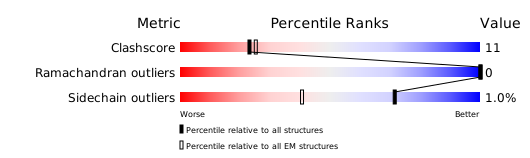
検証レポート(詳細版) をダウンロード
をダウンロード


