






 9LIS
9LIS
CryoEM Structures Uncover the Unexpected Hinges of IscB for Enhanced Gene Editing
9LIS の概要
| エントリーDOI | 10.2210/pdb9lis/pdb |
| EMDBエントリー | 63122 |
| 分子名称 | Iscb, RNA (190-MER), DNA (5'-D(P*CP*TP*CP*AP*AP*CP*CP*AP*CP*CP*TP*AP*C)-3'), ... (6 entities in total) |
| 機能のキーワード | iscb, hnh, rna binding protein |
| 由来する生物種 | synthetic construct 詳細 |
| タンパク質・核酸の鎖数 | 4 |
| 化学式量合計 | 132718.56 |
| 構造登録者 | |
| 主引用文献 | Wang, F.,Guo, R.,Zhang, S.,Cui, Y.,Wang, J.,Hu, T.,Liu, K.,Wang, Q.,Liu, Y.,Nam, K.H.,Zhao, Z.W.,Ji, Q.,Xu, X.,Wang, E.,Zhu, Y.,Yang, Y.,Luo, M.,Ma, P.,Ma, S.,Xu, C.,Hu, C. Structural insight into IscB's RNA-lid-based inactivation mechanism. Nat.Struct.Mol.Biol., 33:603-614, 2026 Cited by PubMed Abstract: IscB, a compact Cas9 ancestor from the obligate mobile element guided activity system, has attracted growing interest as a programmable genome editor because of its small size and therapeutic delivery potential. Despite its promise, structural insights into IscB's regulation remain limited, with only a target-bound R-loop structure previously reported. Here, we present the structural trajectory of an engineered IscB, capturing its transition from a resting state to activation. Using cryo-electron microscopy, we resolve four high-resolution structures: the apo resting state, two intermediate complexes with 6-nt and 10-nt guide-target pairing and a fully paired 16-nt primed cleavage state. These structures uncover a dual inactivation mechanism mediated by RNA lids; the ωRNA lid blocks HNH domain access, while the guide RNA lid occludes the RuvC active site. As guide-target pairing progresses, the guide RNA undergoes a stepwise displacement, mimicking a 'car pedal' motion that triggers activation at 11-nt pairing. The HNH domain also contributes to R-loop stabilization through a positively charged R-wedge motif and undergoes a ~90° activation-driven rotation mediated by two hinge regions. In variants IscBHig1 and IscBHig2, engineering these hinge motifs to enhance conformational flexibility notably improved genome-editing efficiency in cells. In summary, our study reveals the molecular basis underlying IscB autoinhibition and activation, identifies previously uncharacterized regulatory features and establishes hinge elements as a target region for engineering compact, efficient genome editors. PubMed: 41882346DOI: 10.1038/s41594-026-01761-3 主引用文献が同じPDBエントリー |
| 実験手法 | ELECTRON MICROSCOPY (3.39 Å) |
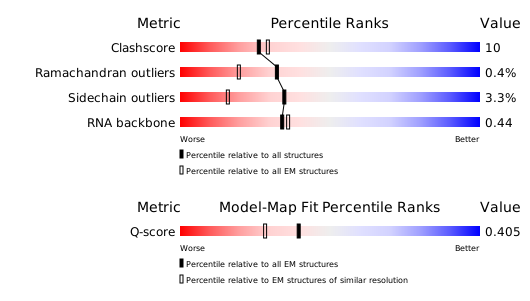
構造検証レポート
検証レポート(詳細版) をダウンロード
をダウンロード


