






9LE1
Consensus olfactory receptor bmOR6A2 in complex with mini-Golf trimeric protein
This is a non-PDB format compatible entry.
Summary for 9LE1
| Entry DOI | 10.2210/pdb9le1/pdb |
| EMDB information | 63012 |
| Descriptor | Guanine nucleotide-binding protein G(I)/G(S)/G(T) subunit beta-1, Guanine nucleotide-binding protein G(I)/G(S)/G(O) subunit gamma-2, bmOR6A2, ... (6 entities in total) |
| Functional Keywords | complex, membrane protein, gpcr, membrane protein/immune system, membrane protein-immune system complex |
| Biological source | Homo sapiens (human) More |
| Total number of polymer chains | 5 |
| Total formula weight | 136666.50 |
| Authors | |
| Primary citation | Wang, T.,Wu, Y.,Wang, L.,Li, S.,Zhao, F.,Wu, L.,Liu, Y.,Qin, J.,Tan, Q.,Liu, J.,Zeng, L.,Chen, Y.,Gao, S.,Shui, W.,Zhao, S.,Hua, T.,Liu, Z.J. Structural decoding of reversible covalent linkage of odorants in human olfactory receptor OR6A2. Cell, 2026 Cited by PubMed Abstract: Olfactory receptors (ORs) are a diverse superfamily of G protein-coupled receptors responsible for odor detection that are also implicated in non-olfactory physiological functions. OR6A2, a class II OR, selectively senses medium-chain aldehydes and belongs to a cluster of ORs genetically associated with the "soapy" perception of cilantro. It also modulates macrophage-mediated inflammatory responses. Structural studies of ORs have long been challenging. Using a back-mutation strategy, we engineered a functional OR6A2 variant (bmOR6A2) from a consensus OR6 (consOR6). Structures of bmOR6A2 in complex with aldehydes reveal a novel ligand-recognition mechanism involving a reversible Schiff base linkage with residue K, validated by mass spectrometry. By integrating structures of consOR6, molecular dynamics simulations, and functional assays, we identified a conserved DYY triad critical for activation in class II ORs. These findings establish a practical strategy for decoding odorant recognition, offering new insights into olfaction signaling and applications in fragrance and therapeutic development. PubMed: 41570822DOI: 10.1016/j.cell.2025.12.017 PDB entries with the same primary citation |
| Experimental method | ELECTRON MICROSCOPY (3.3 Å) |
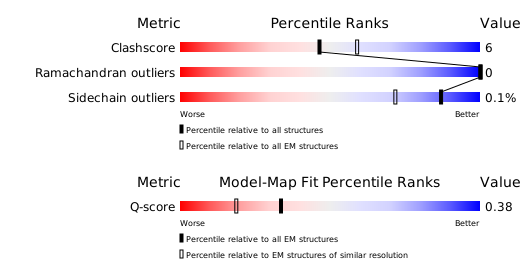
Structure validation
Download full validation report


