






 9KQW
9KQW
eudesmanediol synthase complexed with Mg2+,PPi and BTAC(PeTS3 complex)
9KQW の概要
| エントリーDOI | 10.2210/pdb9kqw/pdb |
| 分子名称 | Terpenoid synthase, PYROPHOSPHATE 2-, N-benzyl-N,N-diethylethanaminium, ... (5 entities in total) |
| 機能のキーワード | terpene synthase, eudesmanediol, ppi, btac, lyase |
| 由来する生物種 | Penicillium expansum |
| タンパク質・核酸の鎖数 | 2 |
| 化学式量合計 | 76294.12 |
| 構造登録者 | |
| 主引用文献 | Huang, Z.Y.,Xu, K.,Li, W.L.,Li, C.X.,Pan, J.,Wu, R.,Xu, J.H. Dihydroxy Terpene Synthase: Spatiotemporally Precise Manipulation of Water-Mediated Dihydroxylation via Stepwise Quenching of Carbocations. J.Am.Chem.Soc., 147:45822-45831, 2025 Cited by PubMed Abstract: Biosynthesis of hydroxy terpenes, which possess better solubility and target-binding capability than terpene hydrocarbons, generally needs cascaded catalysis of terpene synthase (TS) and cytochrome P450 oxygenase. Interestingly, some TSs can directly generate hydroxy terpenes (mostly monohydroxy terpenes) independent of oxygenases. There are even rare TSs that can form dihydroxy terpenes directly. Nevertheless, the structure and catalytic mechanism of dihydroxy terpene synthases (DHTSs) remain elusive to date, hindering their practical applications. Through protein crystallography, multiscale simulations, and site-directed mutagenesis, we elucidate a stepwise carbocation quenching mechanism. In this process, two water molecules are strictly manipulated by a dynamic hydrogen-bond network to quench the carbocation intermediates. Most importantly, Tyr312 was identified as the indispensable and irreplaceable residue for initiating the reprotonation of the monohydroxy terpene. The spatiotemporally precise manipulation mechanism of DHTSs enriches the knowledge of TSs and lays a foundation for developing an oxygenase-independent biosynthesis system of multihydroxy terpenes. PubMed: 41273278DOI: 10.1021/jacs.5c19381 主引用文献が同じPDBエントリー |
| 実験手法 | X-RAY DIFFRACTION (1.99 Å) |
構造検証レポート
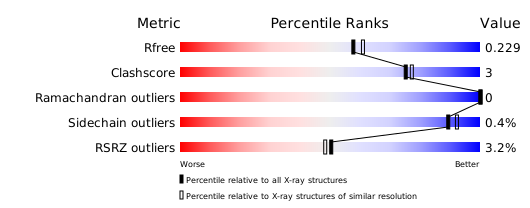
検証レポート(詳細版) をダウンロード
をダウンロード


