






 9KPB
9KPB
Crystal structure of human CASTOR2 in apo form
9KPB の概要
| エントリーDOI | 10.2210/pdb9kpb/pdb |
| 分子名称 | Cytosolic arginine sensor for mTORC1 subunit 2 (2 entities in total) |
| 機能のキーワード | castor2, mtorc1, castor, signaling protein |
| 由来する生物種 | Homo sapiens (human) |
| タンパク質・核酸の鎖数 | 1 |
| 化学式量合計 | 37158.37 |
| 構造登録者 | |
| 主引用文献 | Liu, C.,Zhang, Y.,Wang, Y.,Wu, M.,Li, Y.,Wei, J.,Shi, J.,Wang, R.,Su, L.,Yang, T.,Li, J.,Xiao, J.,Ding, J.,Zhang, T. CASTOR1 and CASTOR2 respond to different arginine levels to regulate mTORC1 activity. Mol.Cell, 86:362-375.e4, 2026 Cited by PubMed Abstract: Mechanistic target of rapamycin complex 1 (mTORC1) is a central regulator of cell growth, responding to amino acid availability. While mTORC1 is modulated by amino acid sensors like CASTOR1, the mechanisms driving its dynamic response to fluctuating amino acid levels remain unclear. Here, we investigate the role of CASTOR2, an understudied CASTOR1 homolog, in regulating mTORC1 activity. We show that CASTOR1 and CASTOR2 bind to arginine similarly but differ in their sensitivity: CASTOR1 responds to low arginine levels, whereas CASTOR2 responds to high arginine concentrations. Both proteins interact with the GATOR2 component Mios, inhibiting its binding to GATOR1. Arginine binding to CASTOR1/2 induces conformational changes at the aspartate kinase, chorismate mutase, and TyrA (ACT) domain (ACT2-ACT4) interface, leading to its dissociation from Mios. Functionally, we demonstrate that CASTOR proteins are highly expressed in muscle tissue and, in C2C12 cells, they regulate mTORC1 and myogenesis in response to different arginine availability. These findings highlight how CASTOR proteins function as dual arginine sensors to fine-tune mTORC1 activity. PubMed: 41506264DOI: 10.1016/j.molcel.2025.12.016 主引用文献が同じPDBエントリー |
| 実験手法 | X-RAY DIFFRACTION (2.5 Å) |
構造検証レポート
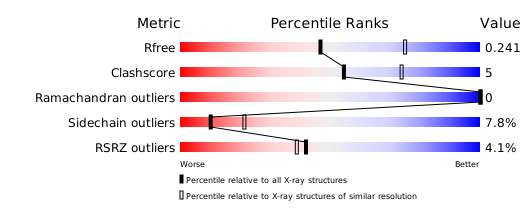
検証レポート(詳細版) をダウンロード
をダウンロード


