






 9K6Z
9K6Z
SARS-CoV-2 related bat coronavirus BANAL-52 spike in the locked state
9K6Z の概要
| エントリーDOI | 10.2210/pdb9k6z/pdb |
| EMDBエントリー | 62143 |
| 分子名称 | Spike glycoprotein, 2-acetamido-2-deoxy-beta-D-glucopyranose, LINOLEIC ACID (3 entities in total) |
| 機能のキーワード | sars-cov-2 related bat coronavirus bana-52 spike with linoleic acid binding, viral protein |
| 由来する生物種 | Horseshoe bat sarbecovirus |
| タンパク質・核酸の鎖数 | 3 |
| 化学式量合計 | 428029.50 |
| 構造登録者 | Li, Q.Q.,Cai, X.,Li, X.N.,Zhang, Y.B.,Li, R.,Kang, Z.R.,Wan, D.D.,Wang, J.X.,Yang, J.X.,Shi, J.X.,Jin, S.L.,Peng, Y.,Zang, N.,Xie, Z.K.,Wan, Y.S.,Shang, J. (登録日: 2024-10-22, 公開日: 2025-07-23, 最終更新日: 2026-02-04) |
| 主引用文献 | Li, Q.,Cai, X.,Li, X.,Zhang, Y.,Li, R.,Kang, Z.,Wan, D.,Wang, J.,Li, L.,Yang, J.,Shi, J.,Jin, S.,Sun, X.,Peng, Y.,Zang, N.,Xie, Z.,Wan, Y.,Shang, J. Structural and functional constraints on spike activation and host protease utilization limit cell entry of SARS-CoV-2-related bat coronaviruses. J.Virol., 99:e0100725-e0100725, 2025 Cited by PubMed Abstract: The persistent threat posed by SARS-CoV-2-related coronaviruses (SC2r-CoVs) in wildlife highlights the risk of zoonotic transmission. Cross-species infectivity is predominantly determined by spike (S) character and S-mediated cell entry. In this study, we systematically investigated BANAL-52 and BANAL-103, which exhibit the closest genetic proximity to SARS-CoV-2, focusing on their spike structures and functional characteristics. First, despite comparable receptor-binding domain (RBD)-ACE2 interactions, the spikes of BANAL-52 and BANAL-103 displayed significantly reduced ACE2 binding compared to SARS-CoV-2, suggesting impaired S activation. Second, Cryo-EM structural analyses revealed that BANAL-52 S is stabilized in a "locked" state through linoleic acid (LA) binding and an additional N370 glycan, whereas BANAL-103 S adopts a "closed" conformation due to a unique glycan network. Site-directed mutagenesis targeting the LA binding pocket confirmed that Y365 is related to S conformational transitions and viral entry. Third, both BANAL spikes relied predominantly on lysosomal proteases (e.g., cathepsins) for membrane fusion, unlike SARS-CoV-2, which utilizes a broader range of proteases (e.g., TMPRSS2 and furin). The introduction of a furin cleavage site enhanced the fusogenicity of BANAL spikes. Finally, sera from individuals who have recovered from SARS-CoV-2 effectively neutralized BANAL pseudoviruses, underscoring conserved antigenicity. Our findings elucidate structural and proteolytic barriers that restrict the zoonotic potential of these viruses and propose targeted surveillance strategies to preempt the emergence of SC2r-CoVs. PubMed: 40704806DOI: 10.1128/jvi.01007-25 主引用文献が同じPDBエントリー |
| 実験手法 | ELECTRON MICROSCOPY (3.51 Å) |
構造検証レポート
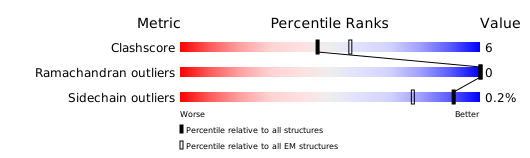
検証レポート(詳細版) をダウンロード
をダウンロード


