






9K3F
Cryo-EM structure of the unliganded human melanocortin receptor 3 (MC3R)-Gs complex
9K3F の概要
| エントリーDOI | 10.2210/pdb9k3f/pdb |
| EMDBエントリー | 62014 |
| 分子名称 | Melanocortin receptor 3,Melanocortin receptor 3,Melanocortin receptor 3,LgBiT subunit, Guanine nucleotide-binding protein G(i) subunit alpha-1,Guanine nucleotide-binding protein G(s) subunit alpha isoforms short, Guanine nucleotide-binding protein G(I)/G(S)/G(T) subunit beta-1,Guanine nucleotide-binding protein G(I)/G(S)/G(T) subunit beta-1,Guanine nucleotide-binding protein G(I)/G(S)/G(T) subunit beta-1,HiBiT, ... (5 entities in total) |
| 機能のキーワード | human melanocortin receptor 3, g protein-coupled receptor, unliganded, constitutive activity, membrane protein |
| 由来する生物種 | Homo sapiens (human) 詳細 |
| タンパク質・核酸の鎖数 | 5 |
| 化学式量合計 | 174997.47 |
| 構造登録者 | |
| 主引用文献 | Feng, W.,Zhou, Q.,Zheng, C.,Yang, D.,Wang, M.W. Structural basis for the constitutive activity of the melanocortin receptor family. Structure, 33:1074-1087.e5, 2025 Cited by PubMed Abstract: The constitutive activity of melanocortin receptors (MCRs) is integral to several physiological processes. The unliganded cryo-electron microscopy structures of MC1R, MC2R, MC3R, MC4R, and MC5R in complex with G proteins determined at global resolutions of 2.98 Å, 3.01 Å, 2.75 Å, 3.12 Å, and 2.86 Å, respectively, revealed that their binding poses and interactions with G are similar to those of agonist-bound MCRs. The extracellular regions of the transmembrane helices (TMs) exhibit distinct conformational rearrangements, characterized by varying shifts of TM3 and outward displacements of TM4. These variations represent unique structural features of constitutively activated MCRs. Unassigned electron densities were observed within the orthosteric pockets where extensive interactions with cognate ligands occur. In addition, zinc ions, but not calcium, positively regulated MC4R activity in a dose-dependent manner. Our findings provide valuable insights into the molecular mechanisms underlying MCR basal activity and highlight the role of divalent ions in receptor activation. PubMed: 40157361DOI: 10.1016/j.str.2025.03.004 主引用文献が同じPDBエントリー |
| 実験手法 | ELECTRON MICROSCOPY (2.75 Å) |
構造検証レポート
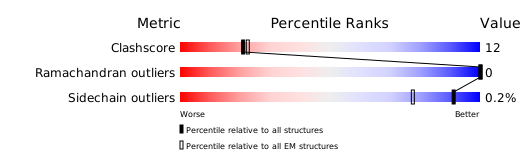
検証レポート(詳細版) をダウンロード
をダウンロード


