






9JXP
Cryo-EM structure of human XPR1-R570L
Summary for 9JXP
| Entry DOI | 10.2210/pdb9jxp/pdb |
| EMDB information | 61871 |
| Descriptor | Solute carrier family 53 member 1 (1 entity in total) |
| Functional Keywords | phosphate channel;phosphate exporter;pfbc, transport protein |
| Biological source | Homo sapiens (human) |
| Total number of polymer chains | 2 |
| Total formula weight | 93008.55 |
| Authors | Wang, X.,Bai, Z.,Wallis, C.,Wang, H.,Han, Y.,Jin, R.,Lei, M.,Gu, C.,Jessen, H.,Shears, S.,Sun, Y.,Corry, B.,Zhang, Y. (deposition date: 2024-10-11, release date: 2025-08-27, Last modification date: 2025-09-17) |
| Primary citation | Wang, X.,Bai, Z.,Wallis, C.,Wang, H.,Han, Y.,Jin, R.,Lei, M.,Yang, T.,Gu, C.,Jessen, H.,Shears, S.,Sun, Y.,Corry, B.,Zhang, Y. KIDINS220 and InsP8 safeguard the stepwise regulation of phosphate exporter XPR1. Mol.Cell, 85:3209-3224.e8, 2025 Cited by PubMed Abstract: XPR1 is emerging as the only known inorganic phosphate (Pi) exporter in humans, critical for Pi homeostasis, with its activity stimulated by inositol pyrophosphate InsP8 and regulated by neuronal scaffold protein KIDINS220. Our structural studies reveal that InsP8 specifically activates XPR1 in a stepwise manner, involving profound SYG1/PHO/XPR1 (SPX) domain movements. Each XPR1 subunit functions with four gating states, in which Pi permeates a constriction site via a "knock-kiss-kick" process. By contrast, KIDINS220 delicately stabilizes XPR1 in a closed conformation through multiple mechanisms, one of which involves trapping the XPR1 α1 helix-critical for InsP8 binding-within an interaction hub. InsP8 serves as a key to release KIDINS220's restraint, reinforcing a "key-to-locks" mechanism to safeguard the stepwise activation. Additionally, our study provides direct structural insights into XPR1-associated neuronal disorders and highlights the evolutionary conservation and divergence among XPR1 orthologs, offering a comprehensive understanding of Pi homeostasis across species. PubMed: 40858110DOI: 10.1016/j.molcel.2025.08.003 PDB entries with the same primary citation |
| Experimental method | ELECTRON MICROSCOPY (3.53 Å) |
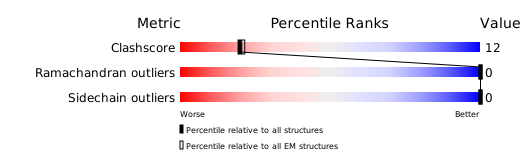
Structure validation
Download full validation report


