






 9JWE
9JWE
Native Carbonic Anhydrase II pH 7.8 0 atm CO2
9JWE の概要
| エントリーDOI | 10.2210/pdb9jwe/pdb |
| 分子名称 | Carbonic anhydrase 2, ZINC ION (3 entities in total) |
| 機能のキーワード | lyase, metal binding protein |
| 由来する生物種 | Homo sapiens (human) |
| タンパク質・核酸の鎖数 | 1 |
| 化学式量合計 | 30183.34 |
| 構造登録者 | |
| 主引用文献 | Lim, S.W.,Jeong, H.,Kim, G.H.,Min, D.,Kim, J.K.,Kim, C.U. Conformational flexibility of His200 enables catalytic activity in the T200H mutant of carbonic anhydrase II. Mol.Cells, 48:100226-100226, 2025 Cited by PubMed Abstract: Carbonic anhydrase II (CAII) is one of the most efficient enzymes known, catalyzing the reversible hydration of CO to regulate pH and facilitate CO transport in biological systems. Its exceptional catalytic rate depends on a highly ordered active site composed of a Zn ion and a hydrogen-bonded water network that supports substrate binding, proton transfer, and product release. Among the residues maintaining this network, Thr200 plays a crucial role by stabilizing key water molecules. To investigate the structural and functional consequences of perturbing this network, we examined the T200H mutant of CAII using high-pressure cryocooling and X-ray crystallography under CO pressures of 0, 5, and 20 atm. The crystallographic snapshots captured the resting (T200H-0atm), substrate-bound (T200H-20atm), and product-bound (T200H-5atm) states of the T200H mutant. In the resting state, His200 disrupts the active site by displacing essential water molecules (W1 and W2), thereby impairing the proton transfer pathway. However, the substrate- and product-bound states reveal that His200 exhibits conformational flexibility, allowing partial restoration of the water network required for catalysis. These findings suggest that His200 functions as a dynamic gatekeeper, modulating access of water, substrate, and product to the active site. This structural plasticity explains how the T200H mutant retains partial catalytic activity despite a mutation that would otherwise severely hinder function. Our results provide new insights into active-site dynamics in CAII and offer a foundation for designing isoform-specific inhibitors or engineered carbonic anhydrase variants with tunable catalytic properties. PubMed: 40441537DOI: 10.1016/j.mocell.2025.100226 主引用文献が同じPDBエントリー |
| 実験手法 | X-RAY DIFFRACTION (1.287 Å) |
構造検証レポート
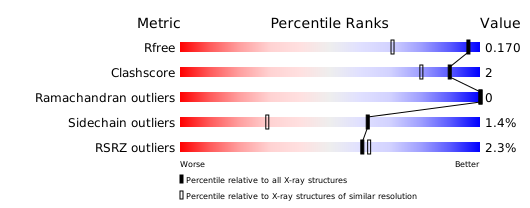
検証レポート(詳細版) をダウンロード
をダウンロード


