






9JPL
Crystal structure of DhdR inducer binding domain in complex with inducer
9JPL の概要
| エントリーDOI | 10.2210/pdb9jpl/pdb |
| 分子名称 | Pyruvate dehydrogenase complex repressor, CHLORIDE ION, (2R)-2-hydroxypentanedioic acid, ... (5 entities in total) |
| 機能のキーワード | transcriptional regulator, transcription |
| 由来する生物種 | Achromobacter denitrificans NBRC 15125 |
| タンパク質・核酸の鎖数 | 2 |
| 化学式量合計 | 51786.17 |
| 構造登録者 | |
| 主引用文献 | Wang, B.,Luo, S.,Sun, P. Development of D2HG biosensors inspired by the molecular mechanism of D2HG regulation of DhdR. Cell Chem Biol, 32:1397-1411.e7, 2025 Cited by PubMed Abstract: Mutant isocitrate dehydrogenases (IDH1/IDH2) catalyze the conversion of α-ketoglutarate (αKG) to D-2-hydroxyglutarate (D2HG), a hallmark of many lower-grade gliomas. Elevated D2HG levels promote tumorigenesis through epigenetic reprogramming and immunosuppressive mechanisms, although paradoxically, D2HG can also inhibit tumor growth. To explore D2HG's biological functions, we developed genetically encoded D2HG biosensors (DHsers) based on the prokaryotic transcriptional regulator DhdR. Structural analysis of DhdR, including its apo form, D2HG-bound complex, and DNA-bound complex, revealed that D2HG binding induces DhdR conformational changes that regulate DNA interaction. Leveraging these insights, we engineered biosensors (DHsers) that detect a wide range of concentrations of D2HG (0.3-30 mM) with high sensitivity. We also established a standardized protocol for quantifying subcellular D2HG levels in living cells. Notably, STING activation promotes D2HG production, suggesting a role of D2HG in immune modulation. Our findings reveal D2HG-induced transcriptional regulation in prokaryotes, offering a platform for studying the role of D2HG in cellular metabolism and tumorigenesis. PubMed: 41202821DOI: 10.1016/j.chembiol.2025.10.004 主引用文献が同じPDBエントリー |
| 実験手法 | X-RAY DIFFRACTION (2.01 Å) |
構造検証レポート
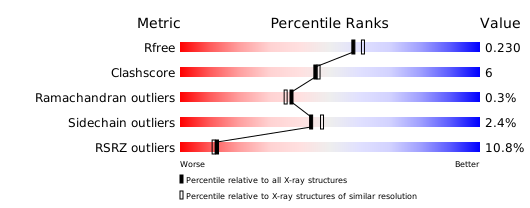
検証レポート(詳細版) をダウンロード
をダウンロード


