






 9JFP
9JFP
Structure of LaTranC complex bound to 6nt complementary DNA substrate
9JFP の概要
| エントリーDOI | 10.2210/pdb9jfp/pdb |
| EMDBエントリー | 61435 |
| 分子名称 | DNA (37-MER), RNA (195-MER), LaTranC, ... (4 entities in total) |
| 機能のキーワード | latranc complexes, immune system/dna/rna, immune system-dna-rna complex |
| 由来する生物種 | Lawsonibacter sp. 詳細 |
| タンパク質・核酸の鎖数 | 4 |
| 化学式量合計 | 139682.12 |
| 構造登録者 | |
| 主引用文献 | Jin, S.,Zhu, Z.,Li, Y.,Zhang, S.,Liu, Y.,Li, D.,Li, Y.,Luo, Y.,Cheng, Z.,Zhao, K.T.,Gao, Q.,Yang, G.,Li, H.,Liang, R.,Zhang, R.,Qiu, J.L.,Zhang, Y.E.,Liu, J.G.,Gao, C. Functional RNA splitting drove the evolutionary emergence of type V CRISPR-Cas systems from transposons. Cell, 188:6283-6300.e22, 2025 Cited by PubMed Abstract: Transposon-encoded TnpB nucleases gave rise to type V CRISPR-Cas12 effectors through multiple independent domestication events. These systems use different RNA molecules as guides for DNA targeting: transposon-derived right-end RNAs (reRNAs or omega RNAs) for TnpB and CRISPR RNAs for type V CRISPR-Cas systems. However, the molecular mechanisms bridging transposon activity and CRISPR immunity remain unclear. We identify TranCs (transposon-CRISPR intermediates) derived from distinct IS605- or IS607-TnpB lineages. TranCs utilize both CRISPR RNAs and reRNAs to direct DNA cleavage. The cryoelectron microscopy (cryo-EM) structure of LaTranC from Lawsonibacter sp. closely resembles that of the ISDra2 TnpB complex; however, unlike a single-molecule reRNA, the LaTranC guide RNA is functionally split into a tracrRNA and crRNA. An engineered RNA split of ISDra2 TnpB enabled activity with a CRISPR array. These findings indicate that functional RNA splitting was the primary molecular event driving the emergence of diverse type V CRISPR-Cas systems from transposons. PubMed: 41027434DOI: 10.1016/j.cell.2025.09.004 主引用文献が同じPDBエントリー |
| 実験手法 | ELECTRON MICROSCOPY (2.96 Å) |
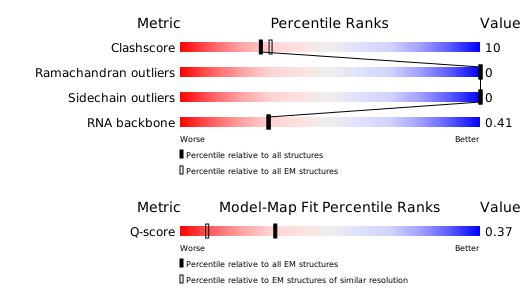
構造検証レポート
検証レポート(詳細版) をダウンロード
をダウンロード


