






9J8K
Crystal structure of the GluA2 ligand binding core (S1S2J) in complex with fluorophore-ligand conjugate
This is a non-PDB format compatible entry.
Summary for 9J8K
| Entry DOI | 10.2210/pdb9j8k/pdb |
| Descriptor | GluA2 ligand binding core, 2-(3-azanyl-6-azanylidene-4,5-disulfo-xanthen-9-yl)-5-[[1-[4-(2-hydroxy-2-oxoethyl)-2,3-bis(oxidanylidene)-7-(trifluoromethyl)-1~{H}-quinoxalin-6-yl]pyrrol-3-yl]methylcarbamoyl]benzoic acid, SULFATE ION, ... (5 entities in total) |
| Functional Keywords | antagonist, complex, signaling protein |
| Biological source | Rattus norvegicus |
| Total number of polymer chains | 1 |
| Total formula weight | 31431.75 |
| Authors | Fujiwara, T.,Adriel, H.,Soga, K.,Kiyonaka, S.,Nango, E. (deposition date: 2024-08-21, release date: 2025-07-02) |
| Primary citation | Soga, K.,Fujiwara, T.,Nakagawa, M.,Shibata, A.,Adriel, H.,Yatsuzuka, K.,Kakegawa, W.,Yuzaki, M.,Hamachi, I.,Nango, E.,Kiyonaka, S. Rapid and reversible fluorescent probe enables repeated snapshot imaging of AMPA receptors during synaptic plasticity. Sci Adv, 11:eadt6683-eadt6683, 2025 Cited by PubMed Abstract: The subcellular localization of neurotransmitter receptors is strictly regulated in neurons. Changes in the trafficking of α-amino-3-hydroxy-5-methyl-4-isoxazolepropionic acid (AMPA)-type glutamate receptors (AMPARs) play an essential role in synaptic plasticity, which is the cellular basis of learning and memory. To explore receptor trafficking, genetically encoded approaches (e.g., the fusion of fluorescent proteins to receptors) are often used. However, concerns remain that genetic approaches cannot fully reproduce the receptor functions that are inherent to neurons. Herein, we report on PFQX1(AF488), a fluorescent probe for the visualization of cell-surface AMPARs without any genetic manipulation to neurons. The rapid and reversible staining features of this probe enabled snapshot imaging, which showed the accumulation of native AMPARs in dendritic spines during synaptic plasticity. Moreover, the mechanism of this synaptic accumulation, for which genetically encoded approaches have given controversial results, was revealed by integrating two chemical methods: PFQX1(AF488) and covalent chemical labeling. PubMed: 40479050DOI: 10.1126/sciadv.adt6683 PDB entries with the same primary citation |
| Experimental method | X-RAY DIFFRACTION (1.82 Å) |
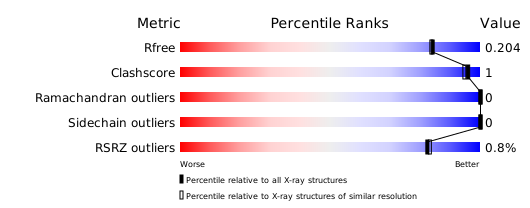
Structure validation
Download full validation report


