






9J61
Crystal structure of a cyclodipeptide synthase from Streptomyces sapporonensis
Summary for 9J61
| Entry DOI | 10.2210/pdb9j61/pdb |
| Descriptor | Cyclodipeptide synthase, 1,2-ETHANEDIOL, GLYCEROL, ... (5 entities in total) |
| Functional Keywords | trna-dependent enzyme, cyclodipeptide synthase, ligase |
| Biological source | Streptomyces cinnamoneus |
| Total number of polymer chains | 8 |
| Total formula weight | 228784.54 |
| Authors | |
| Primary citation | He, J.B.,Ren, Y.,Li, P.,Liu, Y.P.,Pan, H.X.,Huang, L.J.,Wang, J.,Fang, P.,Tang, G.L. Crystal Structure and Mutagenesis of an XYP Subfamily Cyclodipeptide Synthase Reveal Key Determinants of Enzyme Activity and Substrate Specificity. Biochemistry, 63:2969-2976, 2024 Cited by PubMed Abstract: Cyclodipeptide synthases (CDPSs) catalyze the synthesis of diverse cyclodipeptides (CDPs) by utilizing two aminoacyl-tRNA (aa-tRNA) substrates in a sequential ping-pong reaction mechanism. Numerous CDPSs have been characterized to provide precursors for diketopiperazines (DKPs) with diverse structural characteristics and biological activities. BcmA, belonging to the XYP subfamily, is a cyclo(l-Ile-l-Leu)-synthesizing CDPS involved in the biosynthesis of the antibiotic bicyclomycin. The structural basis and determinants influencing BcmA enzyme activity and substrate selectivity are not well understood. Here, we report the crystal structure of BcmA from . Through structural comparison and systematic site-directed mutagenesis, we highlight the significance of key residues located in the aminoacyl-binding pocket for enzyme activity and substrate specificity. In particular, the nonconserved residues D161 and K165 in pocket P2 are essential for the activity of BcmA without significant alteration of the substrate specificity, while the conserved residues F158 as well as F210 and S211 in P2 are responsible for determining substrate selectivity. These findings facilitate the understanding of how CDPSs selectively accept hydrophobic substrates and provide additional clues for the engineering of these enzymes for synthetic biology applications. PubMed: 39475147DOI: 10.1021/acs.biochem.4c00505 PDB entries with the same primary citation |
| Experimental method | X-RAY DIFFRACTION (2.1 Å) |
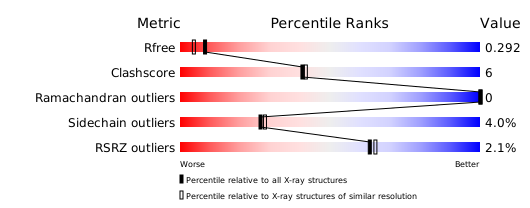
Structure validation
Download full validation report


