






9J0H
The crystal structure of styrene monooxygenase StyA from Streptomyces vilmorinianum
Summary for 9J0H
| Entry DOI | 10.2210/pdb9j0h/pdb |
| Descriptor | styrene monooxygenase/indole monooxygenase family protein (2 entities in total) |
| Functional Keywords | styrene monooxygenase, stya, oxidoreductase |
| Biological source | Streptomyces vilmorinianum |
| Total number of polymer chains | 7 |
| Total formula weight | 334331.54 |
| Authors | |
| Primary citation | Li, Z.P.,Wang, L.,Liu, Y.,Pei, X.Q.,Fatmi, M.Q.,Shen, Z.,Zhao, J.,Lin, H.,Zhou, J.,Wu, Z.L. Structural and Mechanistic Insight into the Enantioselectivity of (R)-Selective Styrene Monooxygenases: A Tug-of-War between Proximal and Distal Residues. Angew.Chem.Int.Ed.Engl., 64:e202423117-e202423117, 2025 Cited by PubMed Abstract: Group E flavoprotein monooxygenases (GEMs) are well-known for catalyzing enantioselective epoxidation reactions. However, engineering their enantioselectivity remains a significant challenge, largely due to a limited understanding of the underlying mechanisms. Among these enzymes, (R)-selective styrene monooxygenases ((R)-SMOs) stand out due to their unusual enantio-switch behavior when catalyzing the reactions of p-substituted styrenes. This unique property provides an exceptional opportunity to investigate the enantiocontrol mechanisms within GEMs. In this study, we resolved the first crystal structure of an (R)-SMO, SeStyA, derived from Streptomyces. By integrating this structural information with molecular docking and molecular dynamics (MD) simulations, we identified four key residues critical to enantiodivergency: two distal residues (S178 and A219) and two proximal residues (A59 and A312). Strikingly, a "tug-of-war" mechanism was revealed through saturation mutagenesis, wherein the side-chain sizes of proximal and distal residues exerted opposing influences on enantioselectivity at the C=C bond. Leveraging this mechanistic insight, we successfully engineered SMOs with excellent (R)- or (S)-enantioselectivity. PubMed: 39950369DOI: 10.1002/anie.202423117 PDB entries with the same primary citation |
| Experimental method | X-RAY DIFFRACTION (2.86 Å) |
Structure validation
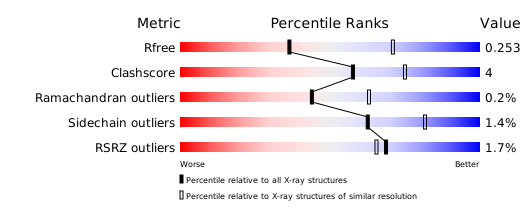
Download full validation report


