






9IR5
Crystal structure of apo-form UDP-N-acetylmuramic Acid L-alanine ligase (MurC) from Roseburia faecis
Summary for 9IR5
| Entry DOI | 10.2210/pdb9ir5/pdb |
| Related | 9IR6 |
| Descriptor | UDP-N-acetylmuramate--L-alanine ligase, 1,2-ETHANEDIOL (3 entities in total) |
| Functional Keywords | murc, peptidoglycan, ligase |
| Biological source | Roseburia faecis |
| Total number of polymer chains | 1 |
| Total formula weight | 50383.08 |
| Authors | Wang, Y.X.,Du, Y.H. (deposition date: 2024-07-14, release date: 2025-04-09, Last modification date: 2025-06-11) |
| Primary citation | Du, Y.,Wang, Y.,Yang, M.,Lin, L.,Zhang, J.,Huang, Z.,Liu, C.,Liu, S.,Ma, J.,Yang, C.,Wang, W. Unusual MurC Ligase and Peptidoglycan Discovered in Lachnospiraceae Using a Fluorescent L-Amino Acid Based Selective Labeling Probe. Angew.Chem.Int.Ed.Engl., 64:e202503049-e202503049, 2025 Cited by PubMed Abstract: Developing selective labeling probes for specific bacterial taxa can not only facilitate the study of target bacteria but also deepen our understanding of the microbial diversity at structural and molecular levels. The availability of such probes, however, remains very limited. In this study, by exploiting the variation of amino acids in peptidoglycan stem peptide, we designed a fluorescent L-amino acid probe and found that it can selectively target the family Lachnospiraceae (a major Gram-positive family in murine gut microbiome) in vivo. The following in vitro test using two Roseburia species belonging to this family validated labeling by the probe. We then discovered that the labeling site is the first amino acid (L-alanine in most bacteria), which links the stem peptide with N-acetylmuramic acid, a process catalyzed by a highly conserved enzyme MurC. An enzyme assay of Roseburia MurC demonstrated its ability to conjugate a fluorescent L-amino acid and other non-L-Ala amino acids to UDP-N-acetylmuramic acid. Subsequent X-ray crystallography analysis uncovered a substantially enlarged inner space in this enzyme, which can partially explain its tolerance to these atypical substrates. The resulting unusual peptidoglycan structures lead to significantly reduced activation of the NOD immune receptors, suggesting a new mechanism for the host to accommodate these highly abundant commensals. PubMed: 40152026DOI: 10.1002/anie.202503049 PDB entries with the same primary citation |
| Experimental method | X-RAY DIFFRACTION (2.36 Å) |
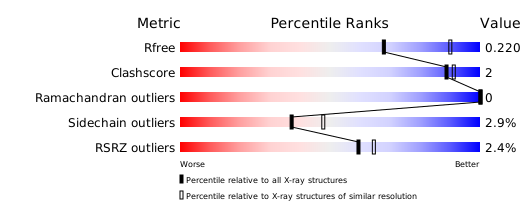
Structure validation
Download full validation report


