






9IPB
Local refinement structure of sEGFR and 528 Fv (from LH-type bispecific diabody Ex3) complex
Summary for 9IPB
| Entry DOI | 10.2210/pdb9ipb/pdb |
| EMDB information | 60768 |
| Descriptor | Epidermal growth factor receptor, 528 Fv from LH-type bispecific diabody Ex3, 2-acetamido-2-deoxy-beta-D-glucopyranose-(1-4)-2-acetamido-2-deoxy-beta-D-glucopyranose, ... (4 entities in total) |
| Functional Keywords | bispecific antibody, diabody, egfr, lh, ex3, 528, local refinement, antitumor protein, antitumor protein-immune system complex, antitumor protein/immune system |
| Biological source | Homo sapiens (human) More |
| Total number of polymer chains | 2 |
| Total formula weight | 97438.91 |
| Authors | Sato, K.,Uehara, S.,Tsugita, A.,Matsui, T.,Asano, R.,Makabe, K.,Yokoyama, T.,Tanaka, Y. (deposition date: 2024-07-10, release date: 2025-05-28, Last modification date: 2025-08-06) |
| Primary citation | Sato, K.,Uehara, S.,Tsugita, A.,Ishii, M.,Ishiyama, S.,Maejima, A.,Nakahara, I.,Nazuka, M.,Matsui, T.,Christos, G.,Yokoyama, T.,Kumagai, I.,Makabe, K.,Asano, R.,Tanaka, Y. Bispecific antibody-antigen complex structures reveal activity enhancement by domain rearrangement. Cell Rep, 44:115965-115965, 2025 Cited by PubMed Abstract: Bispecific antibodies (BsAbs) have been developed as anti-cancer drugs that accumulate activated T cells on cancer cells by bridging the antigens present in each cell. Ex3 is a diabody-type BsAb composed of an anti-epidermal growth factor receptor (EGFR) antibody and an anti-CD3 antibody. In the design of Ex3, the LH-type domain order (Ex3LH) is shown to have more than 100-fold greater anti-cancer activity than the HL-type domain order (Ex3HL). To understand this phenomenon of activity enhancement by domain-order rearrangement, we report here cryoelectron microscopy (cryo-EM) structures of both Ex3HL and Ex3LH in complex with EGFR and CD3. A structural comparison of the HL and LH types reveals that the domain rearrangement leads to drastic structural changes and that the avoidance of steric hindrance by a favorable bridging angle on the cell surface is the fundamental mechanism for this activity enhancement. PubMed: 40664209DOI: 10.1016/j.celrep.2025.115965 PDB entries with the same primary citation |
| Experimental method | ELECTRON MICROSCOPY (2.93 Å) |
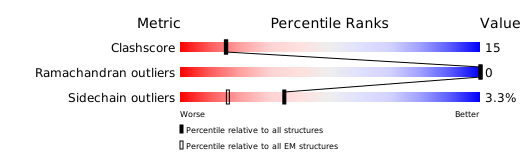
Structure validation
Download full validation report


