






9IC4
Crystal structure of beta-lactamase-like domain of ComEC from Moorella glycerini
Summary for 9IC4
| Entry DOI | 10.2210/pdb9ic4/pdb |
| Descriptor | Competence protein, PHOSPHATE ION (3 entities in total) |
| Functional Keywords | deoxyribonuclease, metallo-beta-lactamase, dna translocation, natural transformation, metal binding protein |
| Biological source | Neomoorella glycerini |
| Total number of polymer chains | 1 |
| Total formula weight | 29203.93 |
| Authors | Stedman, M.J.M.,Wang, D.,Hospenthal, M.K. (deposition date: 2025-02-14, release date: 2025-10-01, Last modification date: 2025-10-08) |
| Primary citation | Stedman, M.J.M.,Deselaers, S.,Braus, S.A.G.,Wang, D.,Balaguer, M.G.,Gossert, A.D.,Hospenthal, M.K. Molecular interplay between ComEC domains allows for selective degradation of the non-translocating strand during natural transformation. Nucleic Acids Res., 53:-, 2025 Cited by PubMed Abstract: Naturally competent bacteria can take up and incorporate environmental DNA using complex machinery in a process called natural transformation. This is a key mechanism in the spread of antibiotic resistance amongst bacteria, including many human pathogens. All competent bacteria require ComEC to transport the transforming DNA across the cytoplasmic membrane. In addition to the transmembrane domain predicted to form the DNA channel, most ComEC orthologues contain an oligonucleotide binding (OB) fold and β-lactamase-like domain. Here, we provide high-resolution structures and an in-depth characterization of the nuclease activity of the β-lactamase-like domain and the DNA-binding activity of the OB fold. We show that the in vitro nuclease activity of the β-lactamase-like domain is enhanced when the OB fold is encoded on the same polypeptide chain. Additionally, we identify a loop within the β-lactamase-like domain, positioned at the entrance of the DNA channel where the duplex DNA separates. Residues in this loop likely guide the non-translocating strand towards the nuclease domain, while a DNA channel lined with aromatic residues provides a path for the translocating strand. On the basis of our biochemical, structural, and functional characterization, we provide a model for how ComEC achieves DNA binding, degradation, and translocation. PubMed: 40985778DOI: 10.1093/nar/gkaf932 PDB entries with the same primary citation |
| Experimental method | X-RAY DIFFRACTION (1.86 Å) |
Structure validation
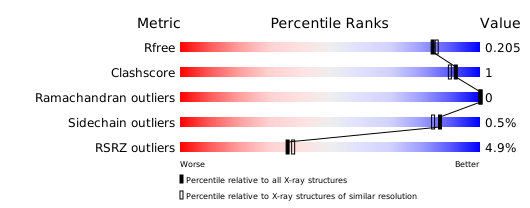
Download full validation report


