






9I9W
Crystal structure containing UGGAA/UGGAA motif interacting with NCD molecule
This is a non-PDB format compatible entry.
Summary for 9I9W
| Entry DOI | 10.2210/pdb9i9w/pdb |
| Descriptor | RNA (5'-R(*GP*GP*CP*AP*CP*UP*GP*GP*AP*AP*GP*UP*GP*C)-3'), 3-[3-[(7-methyl-1,8-naphthyridin-2-yl)carbamoyloxy]propylamino]propyl ~{N}-(7-methyl-1,8-naphthyridin-2-yl)carbamate (3 entities in total) |
| Functional Keywords | rna, uggaa motif, sca31, ncd molecule |
| Biological source | Homo sapiens |
| Total number of polymer chains | 2 |
| Total formula weight | 10594.20 |
| Authors | Mateja-Pluta, M.,Kiliszek, A. (deposition date: 2025-02-07, release date: 2025-09-24, Last modification date: 2025-10-01) |
| Primary citation | Mateja-Pluta, M.,Blaszczyk, L.,Bejger, M.,Nakatani, K.,Kiliszek, A. Naphthyridine carbamate dimer ligand induces formation of Z-RNA-like fold of disease-related RNA and exhibits a molecular glue characteristics in crystal lattice formation. Nucleic Acids Res., 53:-, 2025 Cited by PubMed Abstract: The naphthyridine carbamate dimer (NCD) is a small molecule that recognizes disease-related RNA containing UGGAA repeats associated with spinocerebellar ataxia type 31 (SCA 31) and alleviates the disease phenotype in vitro and in vivo. In this study, we use X-ray crystallography to elucidate the mode of NCD binding in detail. We determine the crystal structures of the RNA-NCD complex and a structure of unliganded RNA. The NCD interacts differently than in previously reported nuclear magnetic resonance structure, forming pseudo-canonical base pairs with guanosine residues located on the same RNA strand. Furthermore, in one of the complexes, the ligand is located between symmetry-related RNA molecules, exhibiting a molecular glue characteristics in crystal lattice formation. The comparison of RNA-NCD and ligand-free models allows the identification of structural changes in RNA upon ligand binding from A-form to Z-RNA-like form. These observations extend our understanding of the interactions between RNA and small compounds and can be useful as a reference model in the development of bioinformatics tools for RNA-ligand structure predictions. PubMed: 40966516DOI: 10.1093/nar/gkaf924 PDB entries with the same primary citation |
| Experimental method | X-RAY DIFFRACTION (1.501 Å) |
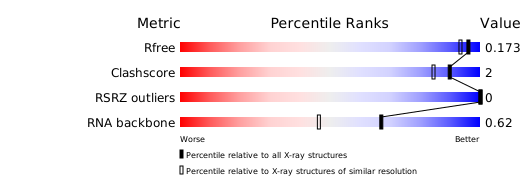
Structure validation
Download full validation report


