






 9I6F
9I6F
Cryo-EM structure of HIGD2A bound complex IV
Summary for 9I6F
| Entry DOI | 10.2210/pdb9i6f/pdb |
| EMDB information | 52613 52654 |
| Descriptor | HIG1 domain family member 2A, mitochondrial, Cytochrome c oxidase subunit 6C, Cytochrome c oxidase subunit 7A2, mitochondrial, ... (21 entities in total) |
| Functional Keywords | human mitochondria, respirasome complex, assembly, cytochrome c oxidase, complex iv, higd2a, membrane protein |
| Biological source | Homo sapiens (human) More |
| Total number of polymer chains | 14 |
| Total formula weight | 246121.64 |
| Authors | Nguyen, M.D.,Rorbach, J.,Singh, V. (deposition date: 2025-01-30, release date: 2025-12-03, Last modification date: 2026-02-25) |
| Primary citation | Nguyen, M.D.,Sierra-Magro, A.,Singh, V.,Khawaja, A.,Timon-Gomez, A.,Barrientos, A.,Rorbach, J. Structural basis for late maturation steps of mitochondrial respiratory chain complex IV within the human respirasome. Nat Commun, 17:1550-1550, 2026 Cited by PubMed Abstract: The mitochondrial respiratory chain comprises four multimeric complexes (CI-CIV) that drive oxidative phosphorylation by transferring electrons to oxygen and generating the proton gradient required for ATP synthesis. These complexes can associate into supercomplexes (SCs), such as the CI + CIII₂ + CIV respirasome, but how SCs form, by joining preassembled complexes or by engaging partially assembled intermediates, remains unresolved. Here, we use cryo-electron microscopy to determine high-resolution structures of native human CI + CIII₂ + CIV late-assembly intermediates. Together with biochemical analyses, these structures show that respirasome biogenesis concludes with the final maturation of CIV while it is associated with fully assembled CI and CIII₂. We identify HIGD2A as a placeholder factor within isolated and supercomplexed CIV that is replaced by subunit NDUFA4 during the last step of CIV and respirasome assembly. This mechanism suggests that placeholders such as HIGD2A act as molecular timers, preventing premature incorporation of NDUFA4 or its isoforms and ensuring the orderly progression of pre-SC particles into functional respirasomes. Since defects in CIV assembly, including NDUFA4 deficiencies, cause severe encephalomyopathies and neurodegenerative disorders, understanding the molecular architecture and assembly pathways of isolated and supercomplexed CIV offers insight into the pathogenic mechanisms underlying these conditions. PubMed: 41519940DOI: 10.1038/s41467-025-68274-3 PDB entries with the same primary citation |
| Experimental method | ELECTRON MICROSCOPY (2.95 Å) |
Structure validation
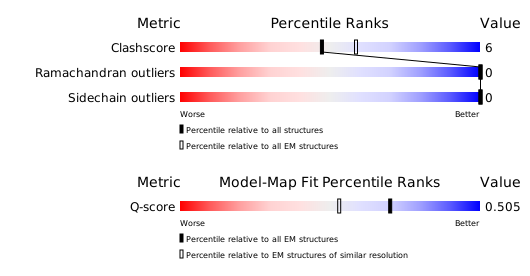
Download full validation report


