






Summary for 9HRU
| Entry DOI | 10.2210/pdb9hru/pdb |
| Descriptor | Lysozyme C, phosphated-cyclotrixylohydroquinoylene, 2-(N-MORPHOLINO)-ETHANESULFONIC ACID, ... (5 entities in total) |
| Functional Keywords | complex, hydrolase |
| Biological source | Gallus gallus (chicken) |
| Total number of polymer chains | 2 |
| Total formula weight | 30706.77 |
| Authors | |
| Primary citation | Wren, C.P.,Flood, R.J.,Mockler, N.M.,Savko, M.,Malinska, M.,Shi, Q.,Crowley, P.B. Protein Recognition and Assembly by a Phosphocavitand. J.Am.Chem.Soc., 147:28107-28116, 2025 Cited by PubMed Abstract: Controlled protein assembly is an enabling technology, in particular, for biomaterials fabrication. Here, we report protein recognition and assembly by a phosphate-containing macrocycle (). We show that the -symmetric phosphocavitand is a versatile receptor for N-terminal residues or arginine but not lysine. Using atomic resolution X-ray diffraction data, we reveal the precise details of N-terminal complexation in the β-propeller protein lectin (RSL). In some cocrystal structures, a tetrahedral cluster of the phosphocavitand occupies one end of the β-propeller fold, providing a node for protein assembly. The macrocycle cluster is compatible with different types of precipitants, a broad pH range, and zinc complexation. We demonstrate system control with an arginine-enriched RSL that alters the overall assembly due to selective arginine complexation by . A lysozyme- cocrystal structure also demonstrates arginine complexation by the macrocycle. An alternative macrocycle cluster occurs with an engineered RSL bearing an extended N-terminus. In this structure, involving zinc ligation at the N-terminus, the macrocycle forms trimeric clusters and four such clusters form cage-like substructures within the tetrahedral protein framework. Thus, N-terminal complexation in combination with phosphocavitand self-assembly provides new routes to protein crystal engineering. PubMed: 40694812DOI: 10.1021/jacs.5c08121 PDB entries with the same primary citation |
| Experimental method | X-RAY DIFFRACTION (1.88 Å) |
Structure validation
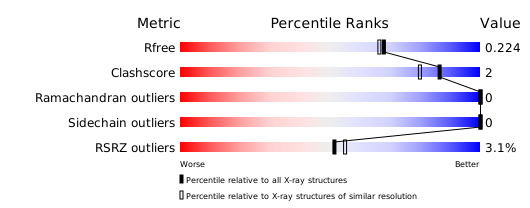
Download full validation report


