






 9HPC
9HPC
The TMD and the LBD region of the AMPAR complex GluA3- TARP gamma2 in the apo state.
9HPC の概要
| エントリーDOI | 10.2210/pdb9hpc/pdb |
| EMDBエントリー | 52325 |
| 分子名称 | Isoform Flip of Glutamate receptor 3,Voltage-dependent calcium channel gamma-2 subunit (1 entity in total) |
| 機能のキーワード | ampar, ion channels, neurotransmission, membrane protein |
| 由来する生物種 | Rattus norvegicus (Norway rat) 詳細 |
| タンパク質・核酸の鎖数 | 8 |
| 化学式量合計 | 1061325.87 |
| 構造登録者 | |
| 主引用文献 | Pokharna, A.,Stockwell, I.,Ivica, J.,Singh, B.,Schwab, J.,Vega-Gutierrez, C.,Herguedas, B.,Cais, O.,Krieger, J.M.,Greger, I.H. Architecture, dynamics and biogenesis of GluA3 AMPA glutamate receptors. Nature, 645:535-543, 2025 Cited by PubMed Abstract: AMPA-type glutamate receptors (AMPARs) mediate the majority of excitatory neurotransmission in the brain. Assembled from combinations of four core subunits, GluA1-4 and around 20 auxiliary subunits, their molecular diversity tunes information transfer and storage in a brain-circuit-specific manner. GluA3, a subtype strongly associated with disease, functions as both a fast-transmitting Ca-permeable AMPAR at sensory synapses, and as a Ca-impermeable receptor at cortical synapses. Here we present cryo-electron microscopy structures of the Ca-permeable GluA3 homomer, which substantially diverges from other AMPARs. The GluA3 extracellular domain tiers (N-terminal domain (NTD) and ligand-binding domain (LBD)) are closely coupled throughout gating states, creating interfaces that impact signalling and contain human disease-associated mutations. Central to this architecture is a stacking interaction between two arginine residues (Arg163) in the NTD dimer interface, trapping a unique NTD dimer conformation that enables close contacts with the LBD. Rupture of the Arg163 stack not only alters the structure and dynamics of the GluA3 extracellular region, but also increases receptor trafficking and the expression of GluA3 heteromers at the synapse. We further show that a mammalian-specific GluA3 trafficking checkpoint determines the conformational stability of the LBD tier. Thus, specific design features define communication and biogenesis of GluA3, offering a framework to examine this disease-associated glutamate receptor. PubMed: 40592473DOI: 10.1038/s41586-025-09325-z 主引用文献が同じPDBエントリー |
| 実験手法 | ELECTRON MICROSCOPY (2.59 Å) |
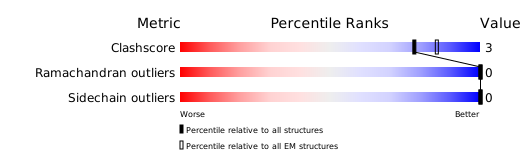
構造検証レポート
検証レポート(詳細版) をダウンロード
をダウンロード


