






9HDG
The structure of the catalytic domain of AfAA11B from the filamentous fungus Aspergillus fumigatus
Summary for 9HDG
| Entry DOI | 10.2210/pdb9hdg/pdb |
| Descriptor | AA11 family lytic polysaccharide monooxygenase B, COPPER (II) ION, ASCORBIC ACID, ... (6 entities in total) |
| Functional Keywords | lytic polysaccharide monooxygenase, chitin, tetraacetyl-chitotetraose, auxillary activity family, aa11, aspergillus fumigatus, lpmo, oxidoreductase |
| Biological source | Aspergillus fumigatus |
| Total number of polymer chains | 1 |
| Total formula weight | 24444.42 |
| Authors | Hall, K.,Roennekleiv, S.E.,Gautieri, A.,Skaali, R.,Rieder, L.,Englund, A.N.,Landsem, E.,Emrich-Mills, T.,Ayuso-Fernandez, I.,Golten, O.,Kjendseth, A.R.,Soerlie, M.,Eijsink, V.G.H. (deposition date: 2024-11-12, release date: 2025-07-09) |
| Primary citation | Hall, K.R.,Elisa Ronnekleiv, S.,Gautieri, A.,Lilleas, H.,Skaali, R.,Rieder, L.,Nikoline Englund, A.,Landsem, E.,Emrich-Mills, T.Z.,Ayuso-Fernandez, I.,Kjendseth Rohr, A.,Sorlie, M.,Eijsink, V.G.H. Structure-Function Analysis of an Understudied Type of LPMO with Unique Redox Properties and Substrate Specificity. Acs Catalysis, 15:10601-10617, 2025 Cited by PubMed Abstract: Lytic polysaccharide monooxygenases (LPMOs) are important biotechnological tools due to their ability to activate C-H bonds in recalcitrant polysaccharides. To-date, most research has focused on LPMOs from the AA9 and AA10 families, while LPMOs from the AA11 family have not received the same attention since their classification almost a decade ago, despite their wide abundance in fungi. Previous studies have shown that AA11B from Aspergillus fumigatus has exceptionally high oxidase activity, low reduction potential and the ability to degrade soluble chitooligomers. To better understand the catalytic capabilities of AA11B, its crystal structure was solved, revealing a unique flexible surface loop that mediates activity on soluble substrates, as shown by molecular dynamics simulations and mutagenesis. Mutation of an active site Glu residue to a Gln, Asp or Asn showed that this residue is crucial in controlling the low reduction potential and high oxidase activity of AA11B. The impact of these mutations on copper reactivity aligned well with results obtained for an AA9 LPMO, which naturally has a Gln in this position. However, the impact of these mutations on the productive peroxygenase reaction, measured using an electrochemical hydrogen peroxide sensor, and on protective hole hopping mechanisms, measured using stopped-flow ultraviolet-visible (UV-vis) spectrophotometry, differed from the AA9 LPMO. This shows that the impact of this Glu/Gln residue is dependent on additional structural or dynamic differences between the LPMOs. Despite the presence of several tryptophan residues in the protein core, the hole hopping studies revealed formation of only a tyrosyl feature with a lifespan distinct from similar features detected in other LPMOs, further highlighting the unique properties of AA11B. PubMed: 40568223DOI: 10.1021/acscatal.5c03003 PDB entries with the same primary citation |
| Experimental method | X-RAY DIFFRACTION (1.26 Å) |
Structure validation
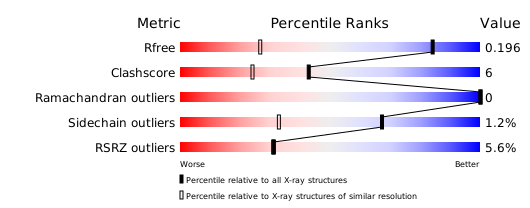
Download full validation report


