






9H7X
SmsC2 dimer from M. jannaschii
Summary for 9H7X
| Entry DOI | 10.2210/pdb9h7x/pdb |
| Descriptor | Uncharacterized ABC transporter ATP-binding protein MJ0035, AMP PHOSPHORAMIDATE, ZINC ION, ... (4 entities in total) |
| Functional Keywords | iron-sulfur cluster, biogenesis, sms, archaea, metal transport |
| Biological source | Methanocaldococcus jannaschii |
| Total number of polymer chains | 2 |
| Total formula weight | 58190.37 |
| Authors | Mechaly, A.E.,Dussouchaud, M.,Haouz, A.,Betton, J.M.,Barras, F. (deposition date: 2024-10-28, release date: 2025-06-04, Last modification date: 2025-08-13) |
| Primary citation | Dussouchaud, M.,Martinez-Carranza, M.,Garcia, P.S.,Clemancey, M.,Blondin, G.,Betton, J.M.,Haouz, A.,Gribaldo, S.,Ollagnier de Choudens, S.,Sauguet, L.,Mechaly, A.,Barras, F. Ancestral [Fe-S] biogenesis system SMS has a unique mechanism of cluster assembly and sulfur utilization. Plos Biol., 23:e3003223-e3003223, 2025 Cited by PubMed Abstract: [Fe-S] clusters are ancient and ubiquitous protein co-factors, which contributed to the emergence of life in an anoxic planet. We have recently identified two minimal [Fe-S] biogenesis systems, MIS and SMS, inferred to be ancestral systems dating back to the Last Universal Common Ancestor and which gave rise to the well-studied modern Iron-Sulfur Cluster (ISC), Nitrogen Fixation (NIF), and Sulfur Mobilization (SUF) machineries. The present study focuses on the ancestor SMS from the hyperthermophilic archaeon Methanocaldococcus jannaschii. Biochemical and structural studies showed that SMS is made of a SmsC2B2 heterotetratmer wherein the SmsC subunit hosts both ATP and [Fe-S] cluster binding sites. Binding of ATP and assembly of [Fe-S] were found to be mutually exclusive allowing for a regulatory coupling between binding of both substrates. Mutagenesis and in vitro transfer experiments revealed the key role of SmsC-contained Cys residues in cluster assembly. Strikingly, the SMS system rescued a non-viable Escherichia coli strain lacking endogenous ISC and SUF systems grown under anoxic conditions, in the presence of Na2S, indicating that sulfide is a source of sulfur for SMS. In addition, we predict that most archaea SmsC proteins hold a similar C-terminal [Fe-S] cluster assembly site. Taking into account those unique structural and functional features, we propose a mechanistic model describing how SmsC2B2 assembles and distributes [4Fe-4S] clusters. Altogether this study established SMS as a new bona fide [Fe-S] biogenesis system that operated in anaerobic prokaryotes prior to evolve to SUF after the Great Oxydation Event. PubMed: 40560930DOI: 10.1371/journal.pbio.3003223 PDB entries with the same primary citation |
| Experimental method | X-RAY DIFFRACTION (2.525 Å) |
Structure validation
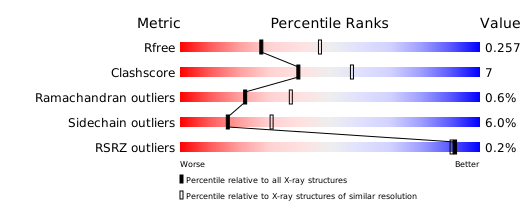
Download full validation report


