






 9GOF
9GOF
MncA bound to nickel
9GOF の概要
| エントリーDOI | 10.2210/pdb9gof/pdb |
| 関連するPDBエントリー | 2VQA |
| 分子名称 | Sll1358 protein, NICKEL (II) ION, GLYCINE, ... (6 entities in total) |
| 機能のキーワード | metalloenzyme, metal binding protein |
| 由来する生物種 | Synechocystis |
| タンパク質・核酸の鎖数 | 3 |
| 化学式量合計 | 119487.44 |
| 構造登録者 | |
| 主引用文献 | Clough, S.E.,Young, T.R.,Tarrant, E.,Scott, A.J.P.,Chivers, P.T.,Glasfeld, A.,Robinson, N.J. A metal-trap tests and refines blueprints to engineer cellular protein metalation with different elements. Nat Commun, 16:810-810, 2025 Cited by PubMed Abstract: It has been challenging to test how proteins acquire specific metals in cells. The speciation of metalation is thought to depend on the preferences of proteins for different metals competing at intracellular metal-availabilities. This implies mis-metalation may occur if proteins become mis-matched to metal-availabilities in heterologous cells. Here we use a cyanobacterial Mn-cupin (MncA) as a metal trap, to test predictions of metalation. By re-folding MncA in buffered competing metals, metal-preferences are determined. Relating metal-preferences to metal-availabilities estimated using cellular metal sensors, predicts mis-metalation of MncA with Fe in E. coli. After expression in E. coli, predominantly Fe-bound MncA is isolated experimentally. It is predicted that in metal-supplemented viable cells metal-MncA speciation should switch. Mn-, Co-, or Ni-MncA are recovered from the respective metal-supplemented cells. Differences between observed and predicted metal-MncA speciation are used to refine estimated metal availabilities. Values are provided as blueprints to guide engineering biological protein metalation. PubMed: 39827241DOI: 10.1038/s41467-025-56199-w 主引用文献が同じPDBエントリー |
| 実験手法 | X-RAY DIFFRACTION (1.6 Å) |
構造検証レポート
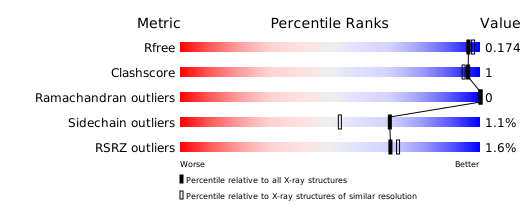
検証レポート(詳細版) をダウンロード
をダウンロード


