






9GA6
The crystal structure of human Annexin A4 derived from crystals grown in 40 mM of CaCl2
Summary for 9GA6
| Entry DOI | 10.2210/pdb9ga6/pdb |
| Descriptor | Annexin A4, CALCIUM ION, GLYCEROL, ... (5 entities in total) |
| Functional Keywords | calcium/phospholipid-binding protein, complex with calcium, signaling protein |
| Biological source | Homo sapiens (human) |
| Total number of polymer chains | 1 |
| Total formula weight | 37733.50 |
| Authors | Vitagliano, L.,Barra, G.,Ghilardi, O.,Di Micco, S.,Bifulco, G.,Campiglia, P.,Sala, M.,Scala, M.C.,Ruggiero, A. (deposition date: 2024-07-26, release date: 2025-06-04) |
| Primary citation | Di Micco, S.,Scala, M.C.,Sala, M.,Barra, G.,Ghilardi, O.,Campiglia, P.,Bifulco, G.,Vitagliano, L.,Ruggiero, A. Computational, crystallographic, and biophysical characterizations provide insights into calcium and phosphate binding by human annexin A4. Int.J.Biol.Macromol., 308:142600-142600, 2025 Cited by PubMed Abstract: The members of the annexin family are proteins involved in important biological processes that share a common propensity, mediated by the binding of calcium, to interact with membranes. Despite the remarkable amount of literature reports on these proteins several aspects of their functionality remain obscure. Considering the importance of the pH in modulating annexin activities, we here reassessed the pH dependency (range 4.6-7.4) of the binding of the calcium by human annexin A4 (hAnxA4) and determined its structure from crystals obtained in acidic conditions at nearly atomic resolution in media containing different calcium concentrations. The interactions of calcium ions with hAnxA4 were studied using isothermal titration calorimetry measurements and molecular dynamics simulations. Present solution data corroborate and quantify the pH dependence of the binding of calcium to hAnxA4. Moreover, crystallographic structures provide a clear ranking of the metal affinity of the hAnxA4 calcium binding sites. These findings have been extended by performing computational studies that provide information on the binding affinity of the different calcium sites that are in good agreement with the crystallographic data. Crystallographic data highlight the occurrence of unexpected clusterings of positively charged arginine residues that can cooperate for the binding of the phospholipid phosphate moieties. These crystallographic data integrated with molecular dynamics simulations provide an atomic-level description of the local conformational changes associated with calcium release and upload. Interestingly, docking analyses demonstrate the optimal juxtaposition of these arginine residues and calcium ions to correctly anchor phosphatidylserine. PubMed: 40157693DOI: 10.1016/j.ijbiomac.2025.142600 PDB entries with the same primary citation |
| Experimental method | X-RAY DIFFRACTION (1.27 Å) |
Structure validation
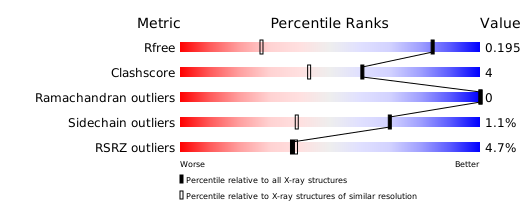
Download full validation report


